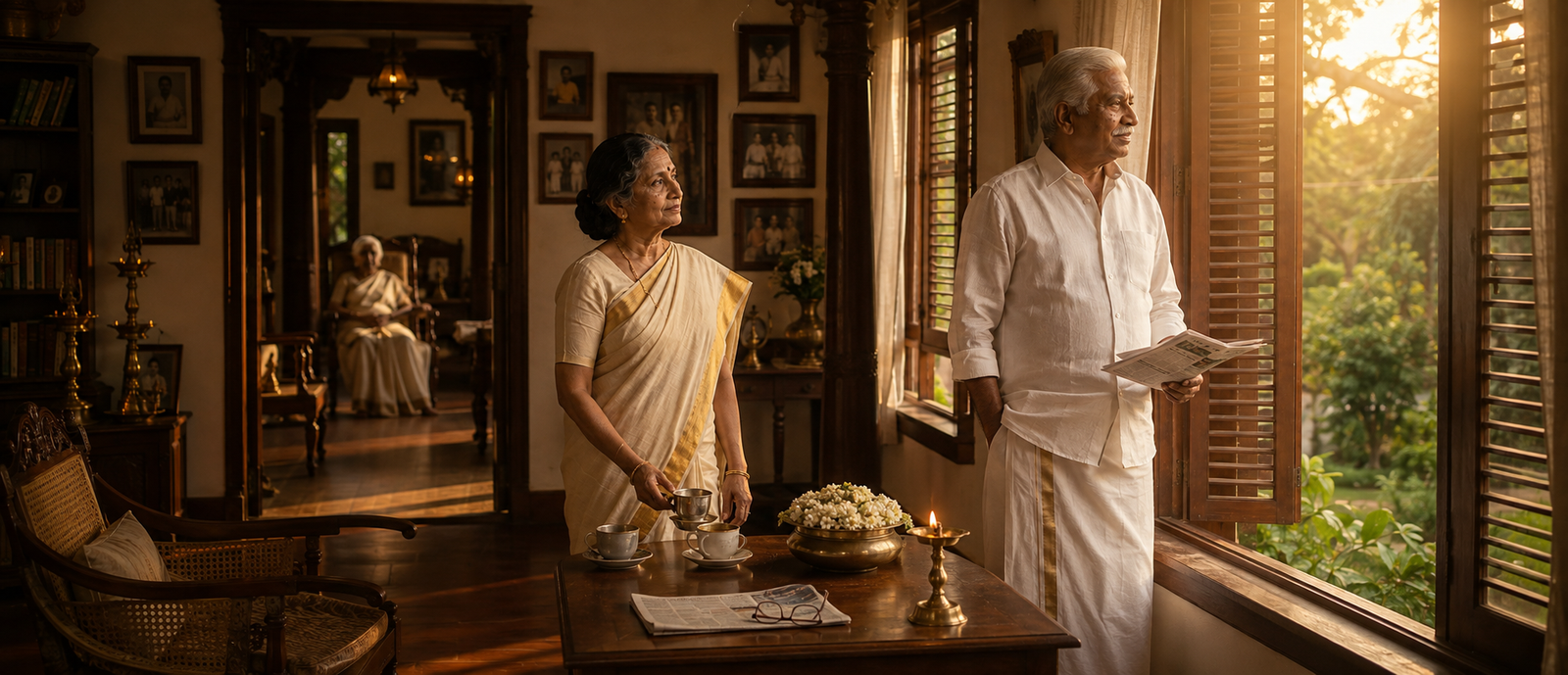
The Marriage
Forty years. Neither has asked the other what it was for.
Forty-one years, and neither has asked
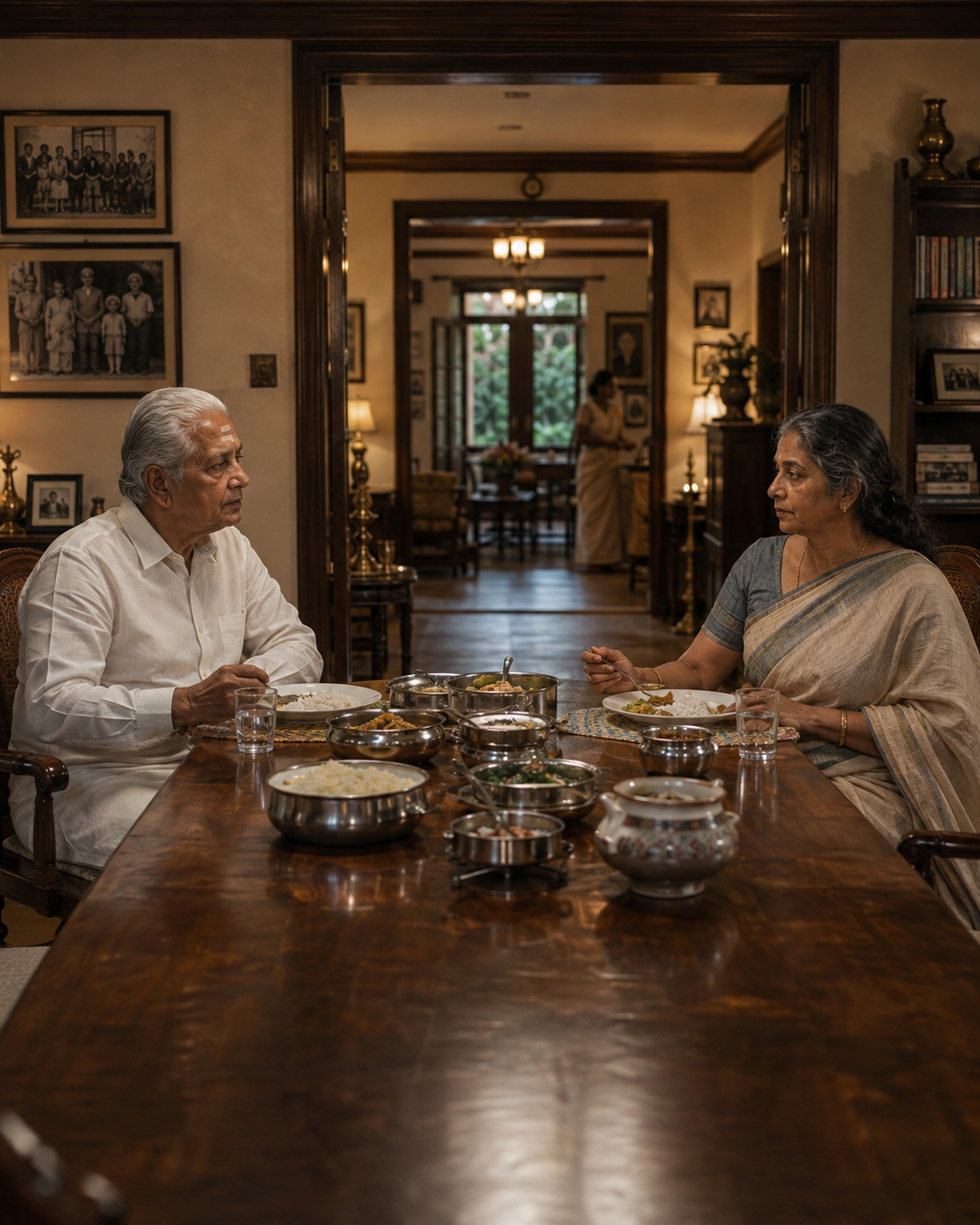
He is seventy. She is sixty. They have been married forty-one years and are kind to each other every day of the week. Dinner is at eight and takes twenty minutes. He asks whether his mother has eaten. She asks whether he has. Then there is nothing, and by half past both have found something else to do. Neither could say when that started, and neither has mentioned it. They are not unhappy, and that is the difficulty. There is no incident either could take to another person and call a wrong.
In those years he built three businesses out of a shed with two lathes in it, and she built the house they eat that dinner in, and not once has either asked the other what any of it was supposed to be for. Eleven people work in that house. Nothing is carried, nothing is queued for, and she has not been asked the price of anything since the nineties. Every decision that used to sit between them at the end of a day left that house one at a time as the money came in, and each one leaving was good news. What to spend. What to put off. Whether the girl could have the extra year.
The same thing, thirty-two years younger
What brought it to a head was their daughter. She is forty-one and married nine years, and in April her mother went to stay three days when the girl had dengue. She watched the two of them hand the house to each other at the door. One coming in as the other went out. Forty seconds. The tablets, the temperature at four, whether the girl had eaten. Affectionate, complete, conducted standing up. Eleven of them, not one gone wrong.
On the second evening her son-in-law came into the kitchen and asked her, kindly, wanting to get it right, what her daughter liked to eat when she was ill. Nine years. She told him. Rasam, thin, and the small potatoes. He wrote it in his phone. Two marriages in one family, thirty-two years apart, running the same silence. Only one can still be changed cheaply, and it is not the older one.
We were the same at their age
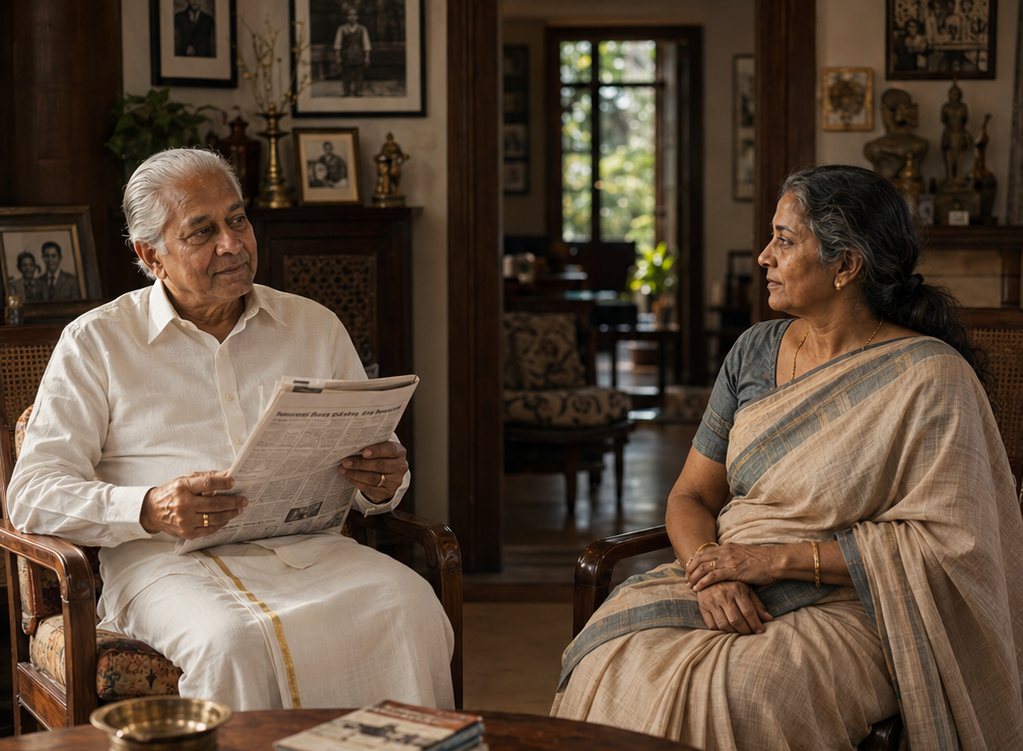
She told him about the flat on the Sunday, in four sentences, because that is how she says things. He said they were fine. Then he said, we were the same at their age.
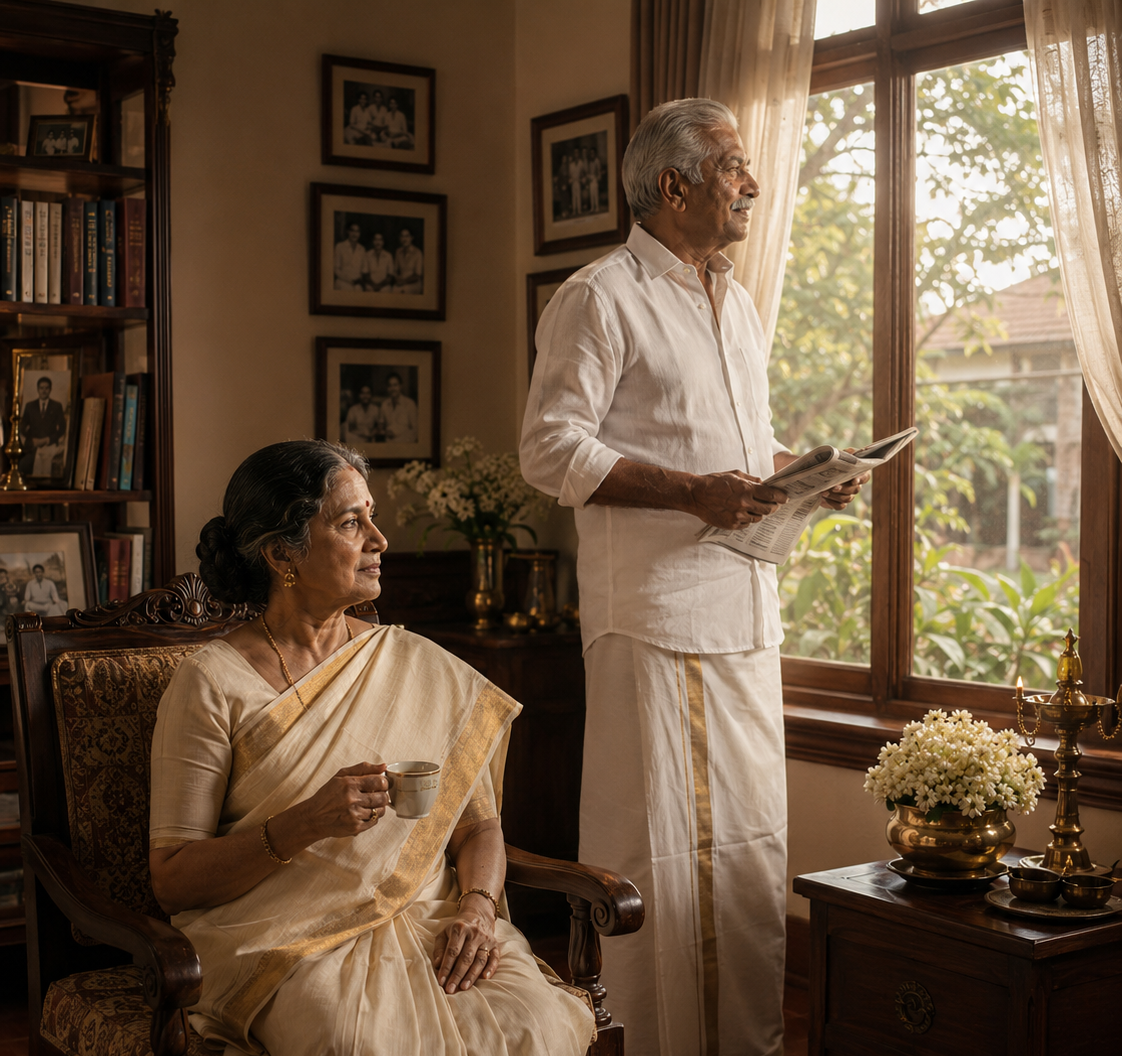
He meant it warmly, as a thing that turned out all right, because from where he sits it did. The house stood. The children came through. Nobody left. She said yes, and he went back to the paper, and somewhere in the two hours after that came out and stood at the window with nothing in his hands.
He rings in June about his daughter
He has had the number for years, since a friend in Calcutta needed it, and never used it. He rang in June. He said his daughter's marriage was in trouble and he wanted somebody to talk to the two of them. That is not what was found, and not what was done.
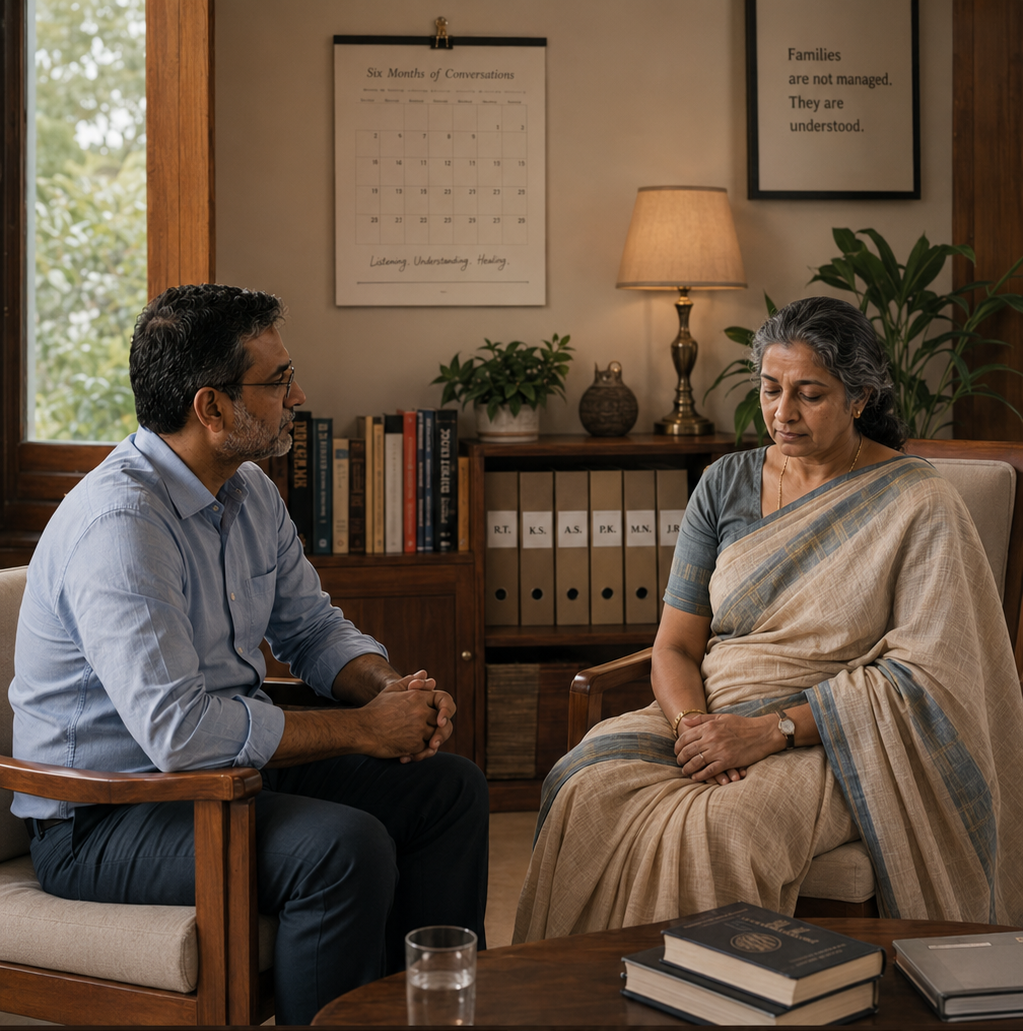
How he works with each of them
Praveen Saanker sees each of them alone, several times, over six months. Some run for hours. None is an interview, and nothing said in one goes anywhere else. He begins with her. Not because she is the wife. Because she is the only one of the four nobody has asked anything. She is asked what she thought it was going to be like. She takes a long time, then says she cannot remember thinking anything at all, and that she has gone over this at night for years.
Their daughter is seen three times, once at an airport. She is asked what she remembers of her parents in a room together, not doing anything. She thinks about it properly, then says she cannot bring one up. Her husband is seen at his own office, never at the house. That was settled in advance and not explained to him. He is easy for two conversations. In the third he stops in the middle of something else and says he has never once been in that house without a reason to be there, and is not sure he knows how to be in his own without one. Then he laughs at himself, asks whether that sounds ridiculous, and moves on before anybody can answer.
The three weeks he did not come

In the third month the father is asked what he thinks his wife wanted all of it for. He says he has never had cause to ask her. Asked again, he says his marriage is not the difficulty here and they should be spending the time on his daughter. He says it pleasantly. He is a courteous man and does not raise his voice in his own office. He says it a second time on the way to the lift. He does not come to the next one. His office moves it, then moves it again, and three weeks go by. He is not called. Nothing is said to his wife, or his daughter, or anybody in that family, and the work with the other three goes on as before.
He rang himself on a Thursday and asked whether the following week was free. What he said when he came was not an apology. He said he had spent three weeks trying to remember his own mother and father alone in a room together and could not do it either, and that his father died when he was eleven, so perhaps that was not fair. Then the thing under it. That he had spent three weeks finding out he did not know how a marriage was supposed to look, and had built one for forty-one years anyway. Sometimes what one of two people needs is not what the two of them need. When it is that, it is said once, privately, to that person, not raised again and not reported to the family, and the work goes on while somebody decides. That is coaching, and it is where it stops.
Who is not in the room, and who told them why
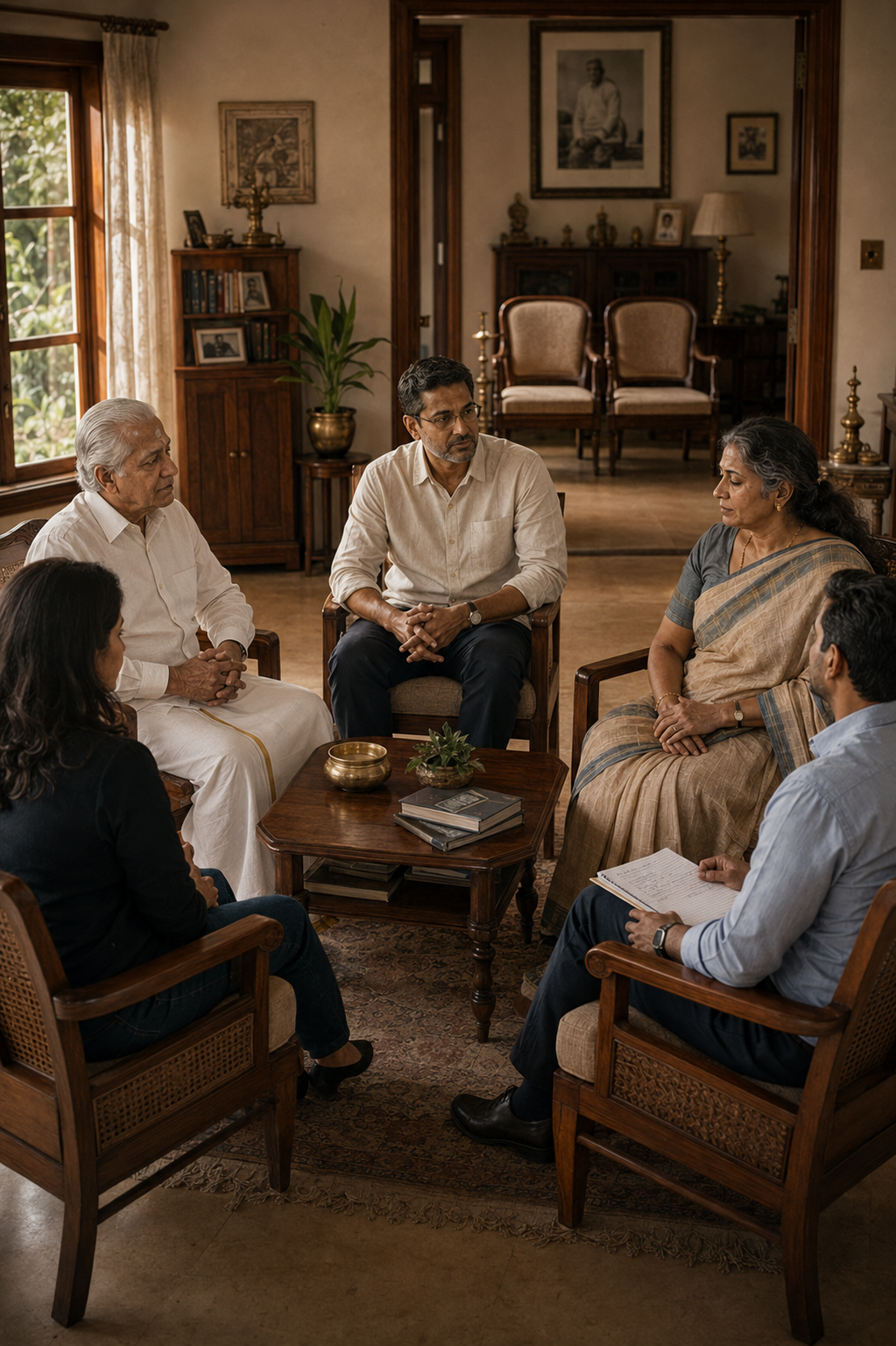
By the fifth month all four of them are sitting in one room at the house. Their son is not there. Neither is his grandmother. Both were told why beforehand, in person, by him and not by the family. A person with no part in a thing is read as having taken a side by noon. The daughter is not seated beside her husband, or the room speaks to her through him for two hours. The son-in-law speaks first, which is the only arrangement in which the man who married in says anything at all. He has come with a page of notes and does not look at it once.
Then the question, put to the older two in front of the younger two. Each is asked what they believe the other one wanted all of it for. He goes first. He says security, in the tone of a man giving the correct answer to a question he has been asked often, which he has not. She says she does not know. It is not taken as an accusation. Then she says she has never known, and is not sure she was ever meant to. Their daughter, not looking at her mother, says she has never in her life heard anybody in that house ask her mother a question. Nobody fills the silence after it.
The thing they have twice let go
They got home after seven and he took his shoes off and stood in the kitchen without putting the light on. She asked what he had thought of it. He said he did not know yet. Then that they had done the same thing twice now, about the child, and both times he was the one who let it go, and told himself it was because she was in the middle of something. She said she knew.
He said he did not know how to ask a woman to want less of a thing she is that good at, and was not going to, and that this was the whole problem and he had no idea what to do with it. His voice went on the last part of that. She put her forehead on his shoulder, which the two of them do not do, and they stood in the unlit kitchen a while.
What she came to say on the Saturday
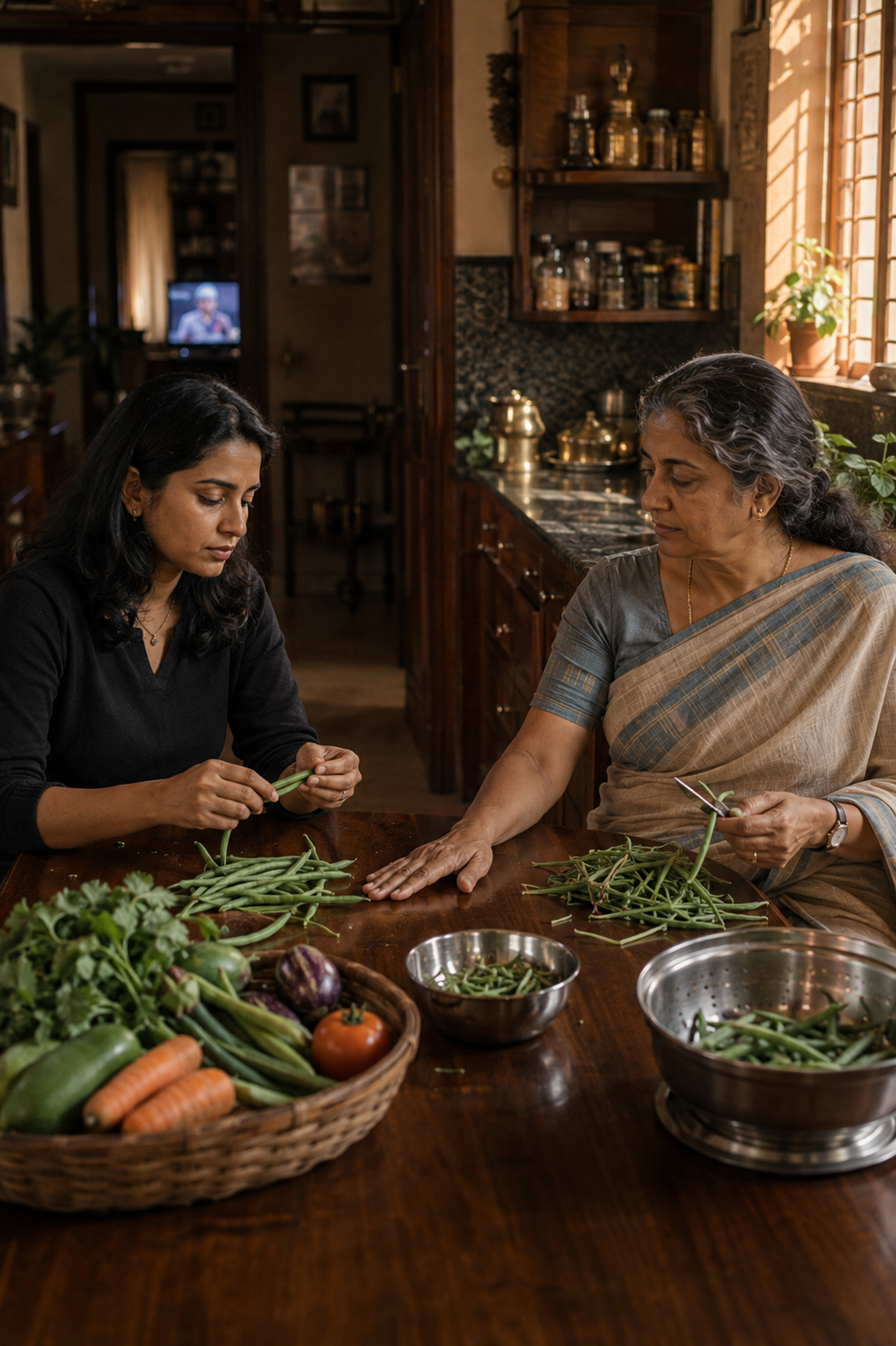
She came to the house on the Saturday, on her own, and did not say why. Her mother was at the table with the vegetables. She sat down and helped, which she has not done since she was a girl, and neither said anything. Then she said sorry for what she had said in that room. Her mother said there was nothing to be sorry for.
She said she had not meant it against her father. Her mother said she knew that, and went on with the beans, and then said, not looking up, that it was the first time anybody had said it. Somewhere in the house a television was on for nobody. After a while her daughter asked, in a voice she has not used since she was nine, whether she was going to be all right. Her mother put her hand flat on the table between them, the way you do when you have decided not to say a thing, and left it there.
The clock
That was a Tuesday. On the Thursday, at home, he started and could not stop. It began with nothing. She had asked whether he wanted the fan on. He said the first thing he ever bought her that they did not need was a — and then could not get it. He said sandals. Then no. Then he was up out of the chair about the shop, and the road it stood on before they widened it, and how he went back three times before he did it, the money in his shirt pocket the whole way. She told him it was a clock.
He said a clock, and sat down. Then he was up again about where they hung it, and that it ran four minutes slow the whole time they owned it and neither ever did a thing about it. He talked for forty minutes. He is not a loud man, and he was loud in his own hall on a Thursday evening, and his mother, ninety, sent word to ask whether anything was wrong. Nothing was wrong. He had answered a question correctly two days before, and it came apart at a fan switch.
What each couple signs, and what only one of them needs
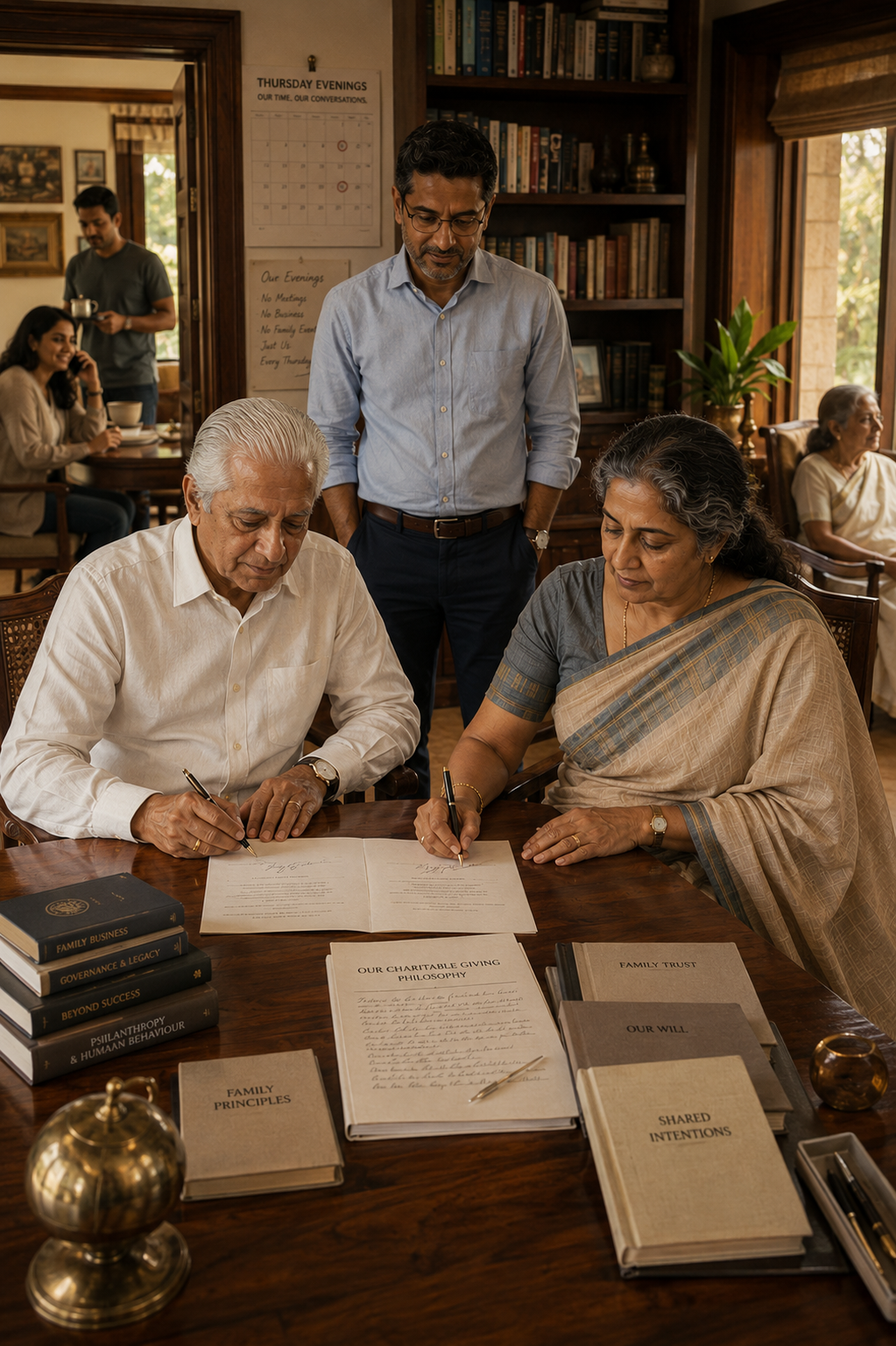
The older two write down what it was for. Six sentences. Eleven weeks. Everything after gets tested against it, and it carries both their names in the same capacity, which no piece of paper in that house ever has. The provision hangs off those six sentences, not a lawyer's default. A will each rather than one between them. What moves now held apart from what moves at death. Fixed dates rather than occasions, because money arriving at a birth is a verdict on the birth. A trust where a trust does a job, outright where it does not. Shareholding kept out, so a document about money does not become one about who runs something. A giving structure with an annual number, and criteria she writes, because what a family owes to people it will never meet is the part nobody else can write. And twice a week, in the diary, with a start time and nothing useful in it. Not a walk with a purpose, not a family occasion. It is the first arrangement in forty-one years that exists for the two of them and nobody else, and it had to be written down, because a thing not written down in that house is given away by Thursday.
The younger two get none of that. They have nothing to settle. What they get is a policy on what reaches their household and on what terms, decided once, on a date, in writing, so money from her father is never a gift and never an opinion. And the same question, put to each separately. The other one they carry is worked elsewhere. This one costs nothing to answer at their age. Two decades in institutional finance sits behind the instruments, at HSBC India and then as a founding-team Director of the family office practice at ASK Wealth Advisors. A doctorate in clinical psychology sits behind the rest, and both halves are done by one person in the same room. Nobody told them to do anything. In the ninth month their daughter mentioned on the phone, in the middle of something else, that they had started keeping Thursday evenings. Her mother said that was nice, put the phone down, and sat where she was a while.
The unlit stretch
He came home in the eighth week, and the first fortnight was worse than either will ever say. They started walking at six, because the afternoons had to go somewhere. Out to the corner by the transformer and back.
In September he asked her the question. His own, badly put, about what she had thought it would be like. She took a while. They came to the corner and neither mentioned it and they kept going, and the road out that way is not lit past the bend. He moved round to the outside, on the traffic side, the way he has since she was nineteen, and the two of them went on down it.