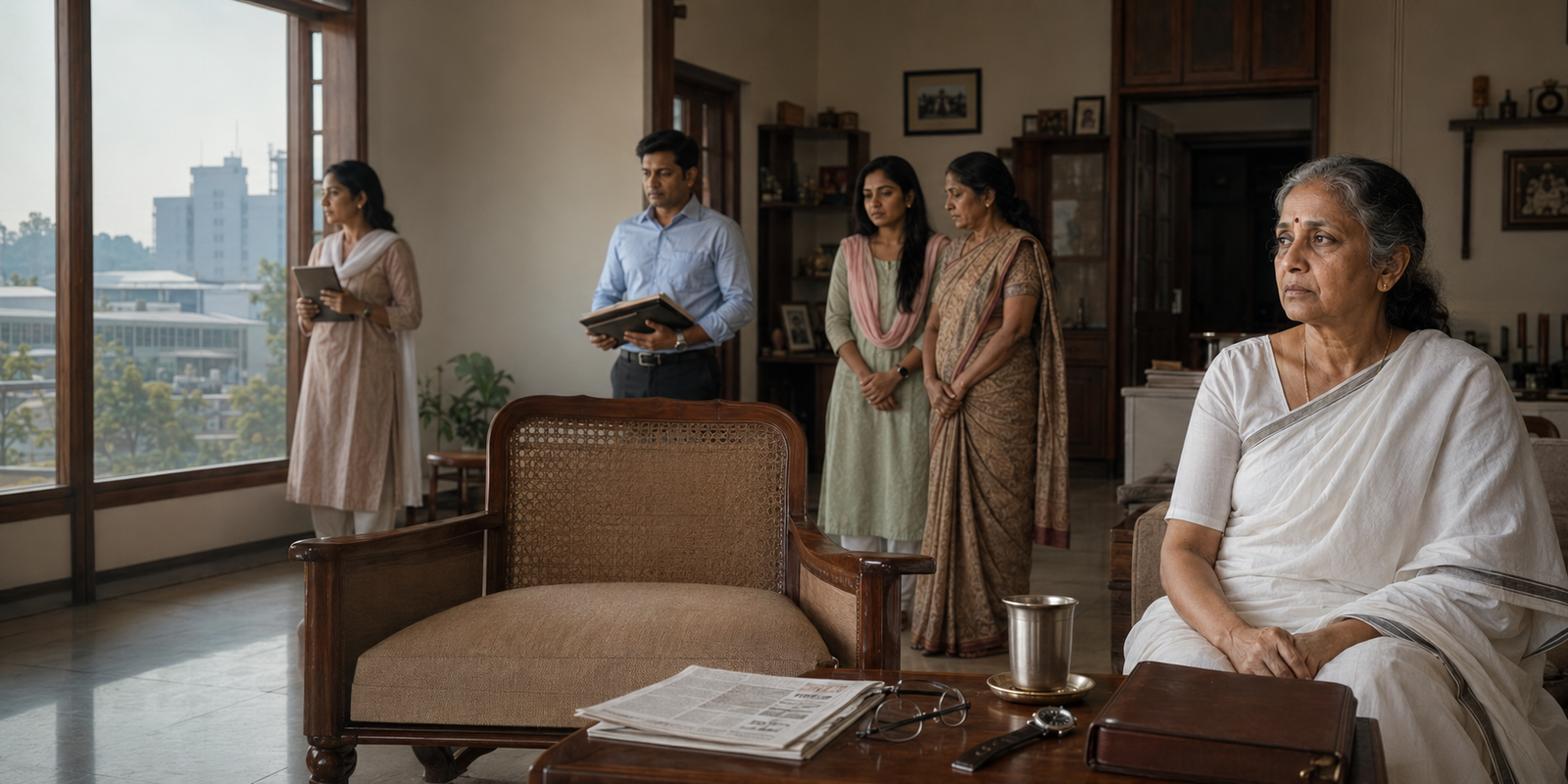
Loss
He is gone. There is a board meeting on Thursday.
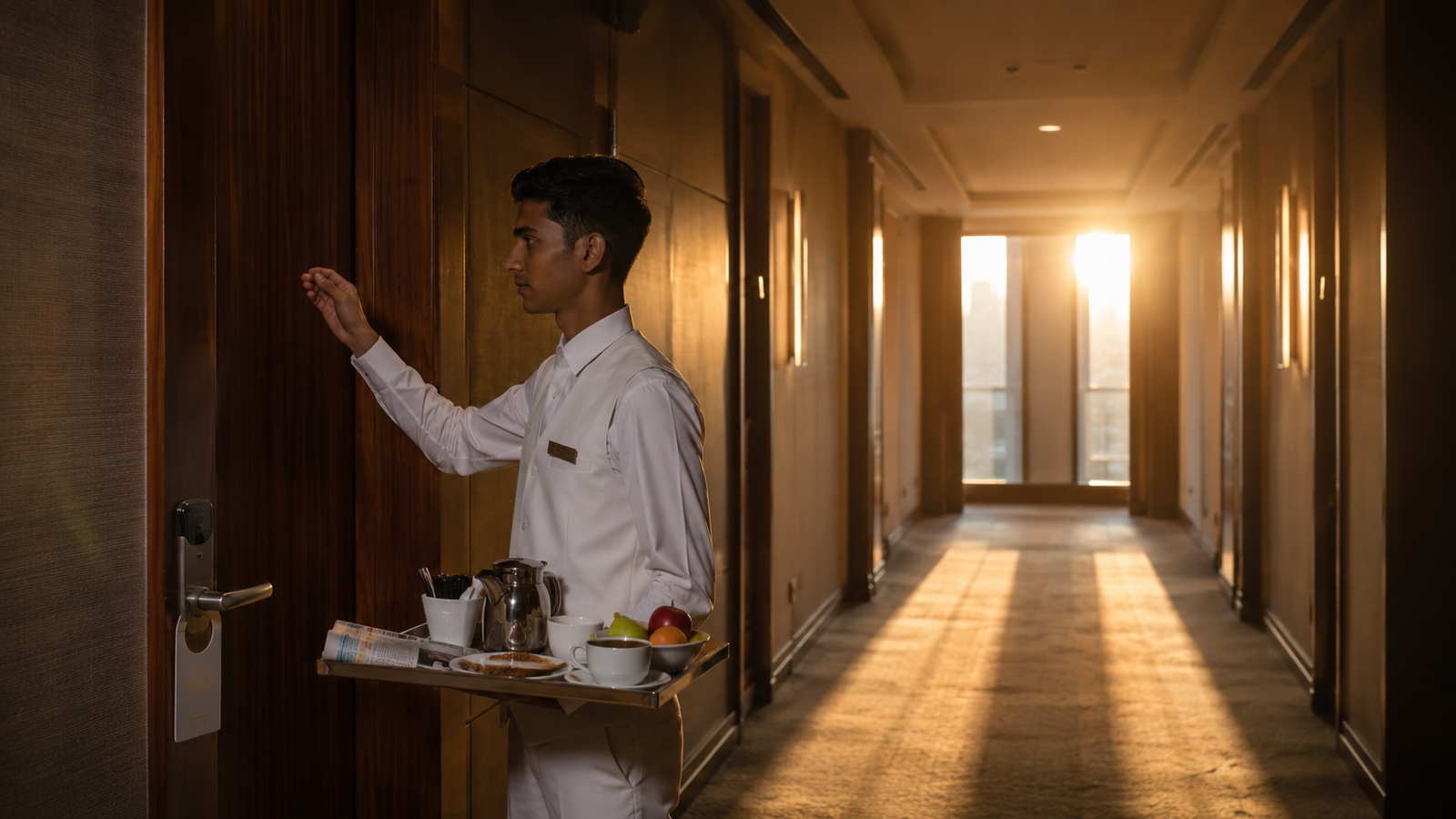
Seven in the morning, and a boy with a tray
He telephoned her at about nine on the Tuesday, from a hotel in Chennai, where he had a meeting at nine-thirty the following day. She asked whether he had eaten. He said he had. She went to bed at half past ten and slept. P. R. Velusamy was sixty-eight and had a heart nobody knew about, including him. He was found at seven the next morning by a boy who came up with the tray. She was five hundred kilometres away and asleep for seven hours of it, and she has not been able to put it down.
The hotel telephoned the number on the booking, and the company telephoned Karthik at twenty past seven. Inside four minutes he had telephoned two people. His sister in Bangalore, because she was the only person he could say it to. Then his wife, because somebody had to be with his mother and he had to be in a car. Divya is thirty-four. She stood in the passage outside her mother-in-law's door for eleven minutes, because there was no version of it she could find, and then she went in.
Sixteen hours in a house with no body in it
A man who dies alone in a hotel room is a police matter and nobody can be persuaded otherwise. There was a post-mortem. The body was released at half past four in the afternoon. Chennai to Coimbatore is nine hours in the evening. They came in at a few minutes past two the next morning.
The house had been full since ten the previous day. Two hundred people came, and then more, and by three they were standing in the road. They had come into a house with no body in it, and there was nothing to do and nowhere to look. Cousins organised things that did not need organising, because organising was available and nothing else was. Nandhini was on the eight-forty flight and in that house by one, which was thirteen hours before her father. The sister came from Erode at noon, sat on the floor beside her and said nothing for three hours.
The questions nobody could answer

By the Saturday people had begun asking her things. Whether Perundurai should run on Monday. Which bank the term loan was with. Whether the Pune customer had been told, and by whom. She did not know one of them. He had told her about his day for forty-two years and not one day of it had ever been about a bank. A man from the plant came about a shipment, stood in the doorway a long while, apologised, and went away without asking. Eleven hundred people work at those three units. That fortnight nobody could tell them anything.
The Thursday
The account ran on one signature, arranged that way in 1994 because a second was a nuisance, and never looked at again. The bank wrote on the eighteenth. The account would take money in and pay nothing out until the company said on paper who could sign. A man brought the letter to the house himself, and was sorry, and could not help it. There was no will. He was sixty-eight and walked every morning and had said something to two people about settling it at seventy-two. So it went in three equal parts, which is what the law does when a man has not said otherwise, and it took a court and most of the year to say so.
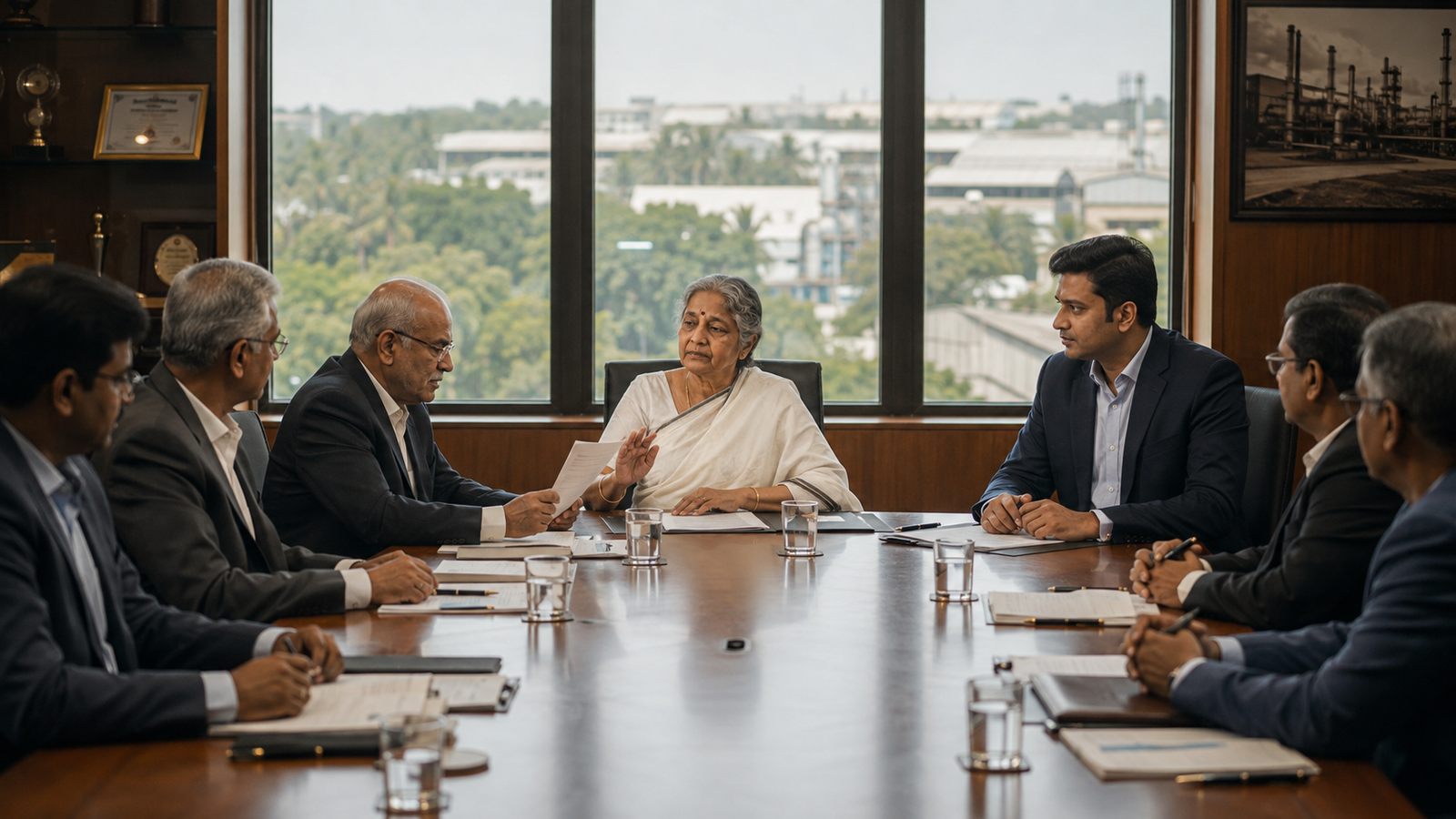
Fourteen days after the cremation she sat in the boardroom of the company he built, in white, and a resolution was read out, and she was asked to raise her hand. She had been inside that building four times in forty-two years. She was now the largest shareholder in it. She raised her hand because everybody else had. It did not reach the branch in time. On the seventh of April eleven hundred people were paid four days late, against a guarantee Karthik gave personally and mentioned to nobody.
The rota
Her sister stayed six weeks. Then Divya. Then relatives in turn, worked out between them on a chart, so the house would not be empty at any hour of any day. Eleven people rearranged their lives to be certain of it. It is the kindest thing anybody has done for her. She has not been alone in a room since the eleventh of March.
Everybody asks her how she is. They ask carefully, and they mean it, and they wait for the answer. Not one of them has asked her about him. They cannot. Every one of them is carrying him too. She asked the driver, in May, what floor the room had been on. He told her. She has not asked anything else since.
A man of seventy, asking for himself
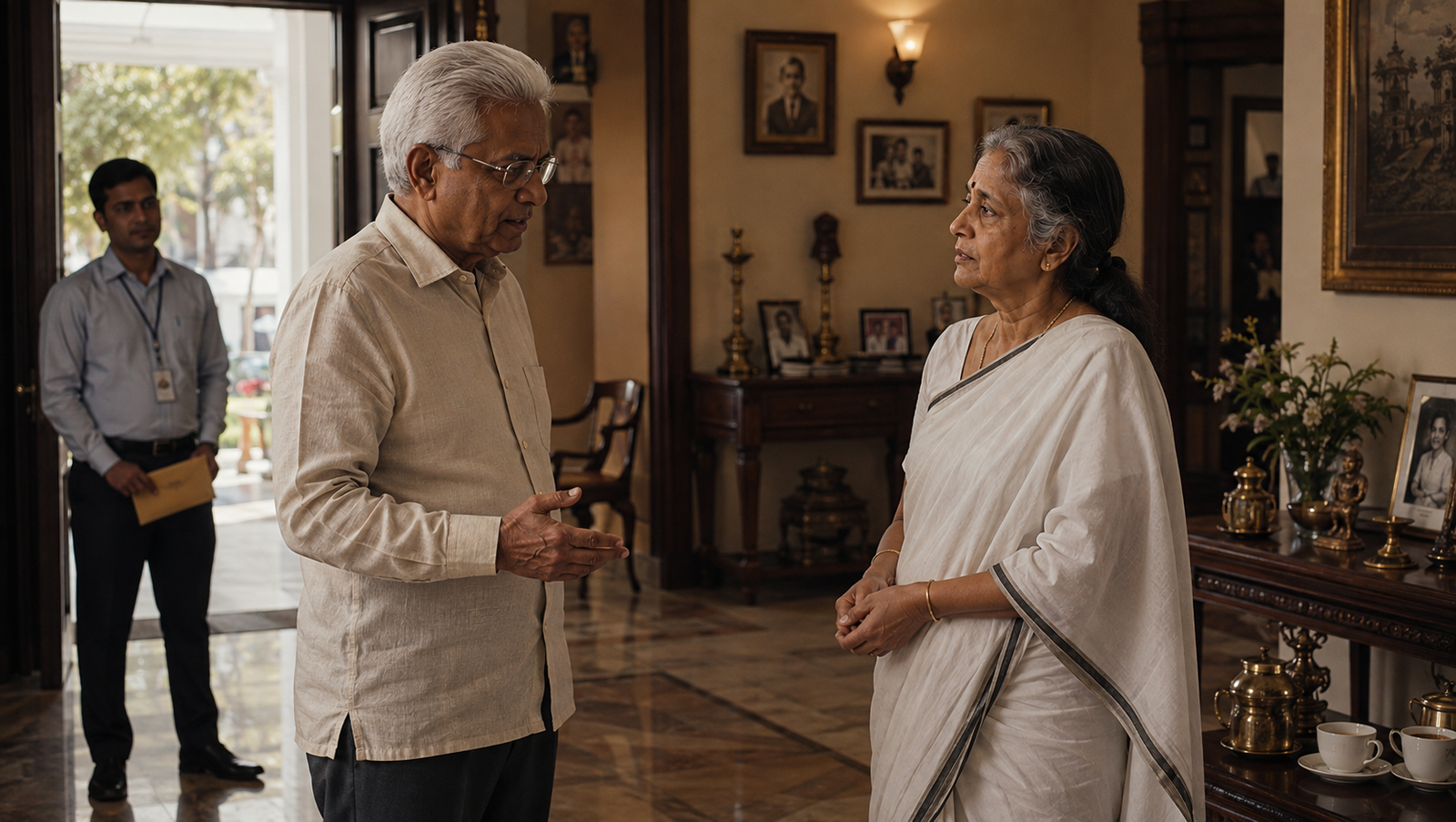
Raghavan came for the cremation, stood at the back with the trade people, and drove home the same night. He came again in April, on his own, and stayed two hours. Four people came to the house while he was sitting there, and one was from the bank. He started on a bad batch in 1986 and did not finish it. On his way out he gave her a name. He did not say she needed anybody. He stood in the hall and said there was a man he would like her to meet, and that he was asking it for himself, because he had not been able to do one thing for her husband. Then he said it again, differently, in case it had come out wrong. She did not telephone in April. She did not telephone for most of May. She telephoned on the last Friday in May, having been asked four questions that week she could not answer, and because a man of seventy had driven six hours twice.
What he asks her, morning after morning
He sees each of them alone, several times. Some run for hours and none is an interview. Nothing said in any of them goes anywhere else, then or afterwards. He was in Coimbatore three days in most weeks for five weeks. The bank had given them until the end of July. He begins with her. They sit in the small room off the kitchen, where she has kept the accounts of that house since 1983 in a hard-bound book, which is the only record of any of it there has ever been. The first three mornings she talks about the company, because that is what she believes he has come for, and apologises twice for not knowing more. He lets her finish. In the fourth he asks her what her husband was like when she married him. She does not answer for a long time. Then she talks for fifty minutes, and somewhere in the middle she goes out of the room, and comes back and sits down and goes on from where she stopped. Nobody had asked her a question about him since the twelfth of March. After that it is what he ate, what he was frightened of in 1991, whether the two of them ever went anywhere alone. She could not answer the last one for nine days. Then she said Kodaikanal, 1989, and that he was bored by the second afternoon and she had known it and had not minded. None of it is worked on. He does not tell her what any of it means, and he writes nothing down.
In the fourth week she put her face in her hands in the middle of a sentence about a shirt he would not throw away. He did not move, and he did not say anything, and he did not go out to find anybody. It went on for some time. Then she sat up and apologised. He told her there was nothing to apologise for. She said, not that, and asked whether he could stay another half an hour, because Divya would be back at eleven.
What he cannot do after dark
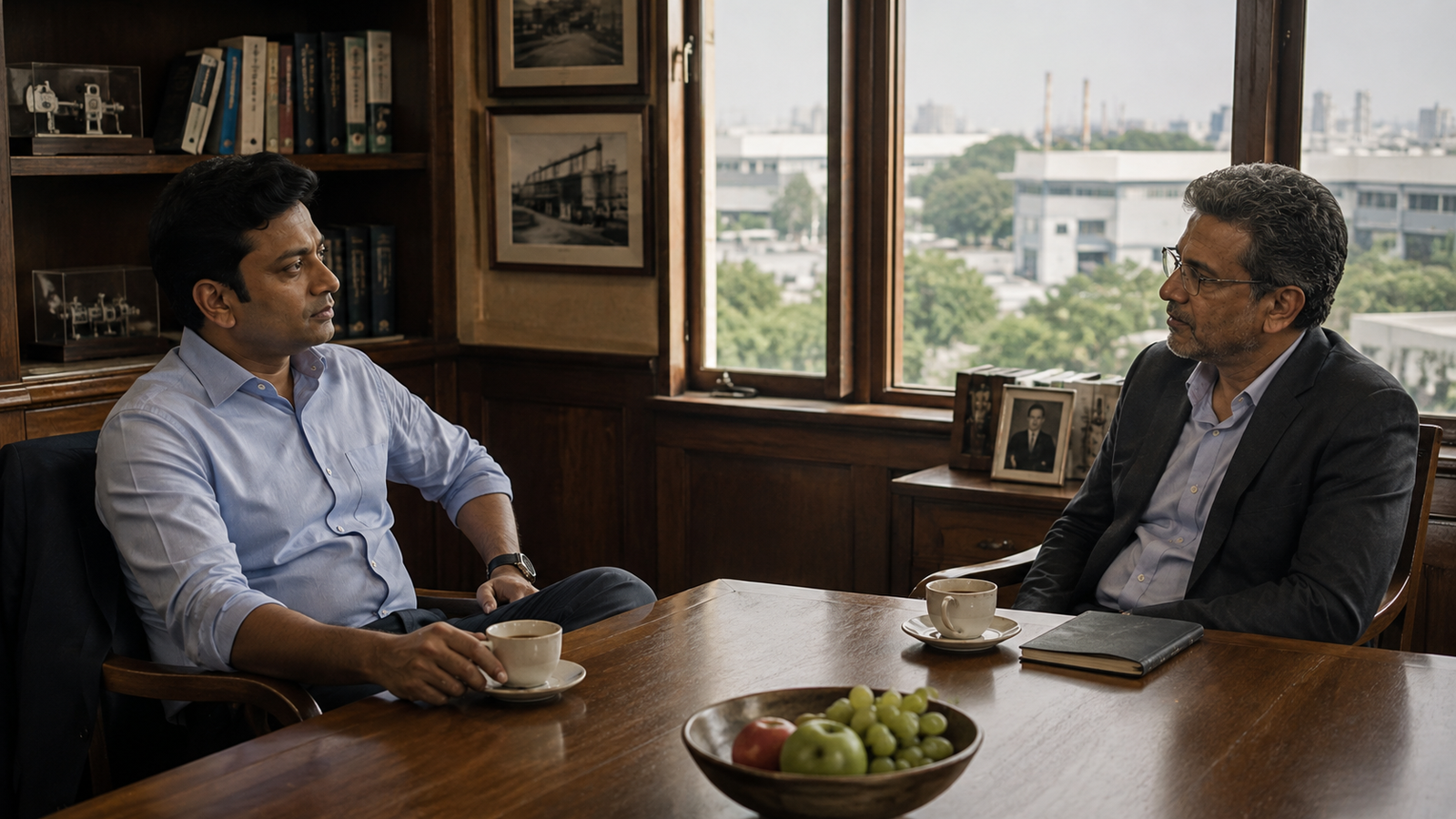
Karthik did what had to be done at the hospital and the police station and the hotel, then drove nine hours behind an ambulance. He has never described any of it to his wife. He cannot now be in a car after dark unless he is the one driving. He says it in the fourth week, at the end of a conversation about something else, half as a joke, and moves on before anybody can answer.
Sometimes what a person needs is coaching. Sometimes what a person needs is therapy. When it is the second, it is said once, privately, to that person. What he does with it is his. Praveen recommends what he believes is right for him and respects the answer. He does not raise it again, and he does not tell the family. The work does not stop while somebody decides. He is there for that family. That is what the family asked him for. What Karthik decided is not known to his mother, or his sister, or to anybody who worked on that company.
Palladam, 1984
Sundaramoorthy is sixty-six. Their fathers were brothers. He came into the foundry in 1984, and since the Thursday in March he has had every item on every agenda deferred, correctly, and the minutes record him as such. He comes in now at a quarter past seven, which is when the other man used to come in. The first two conversations are the company. In the third he starts on 1984 and does not stop.
A lorry of pig iron into a ditch outside Palladam in the floods, the two of them out in the water at eleven at night with a rope, and Velusamy laughing so hard he could not tie it. He is up out of his chair for the lorry. He does the voices. He tells the same part twice because it is better the second time. He is a quiet man. There is nobody left alive who was there. Then he sits down and says he has been the second man in that company for forty-one years and is good at it, and does not know how to be the first one, and cannot say that at sixty-six in a boardroom, because it would be heard as a man asking to be let go.
Fourteen things she had not read
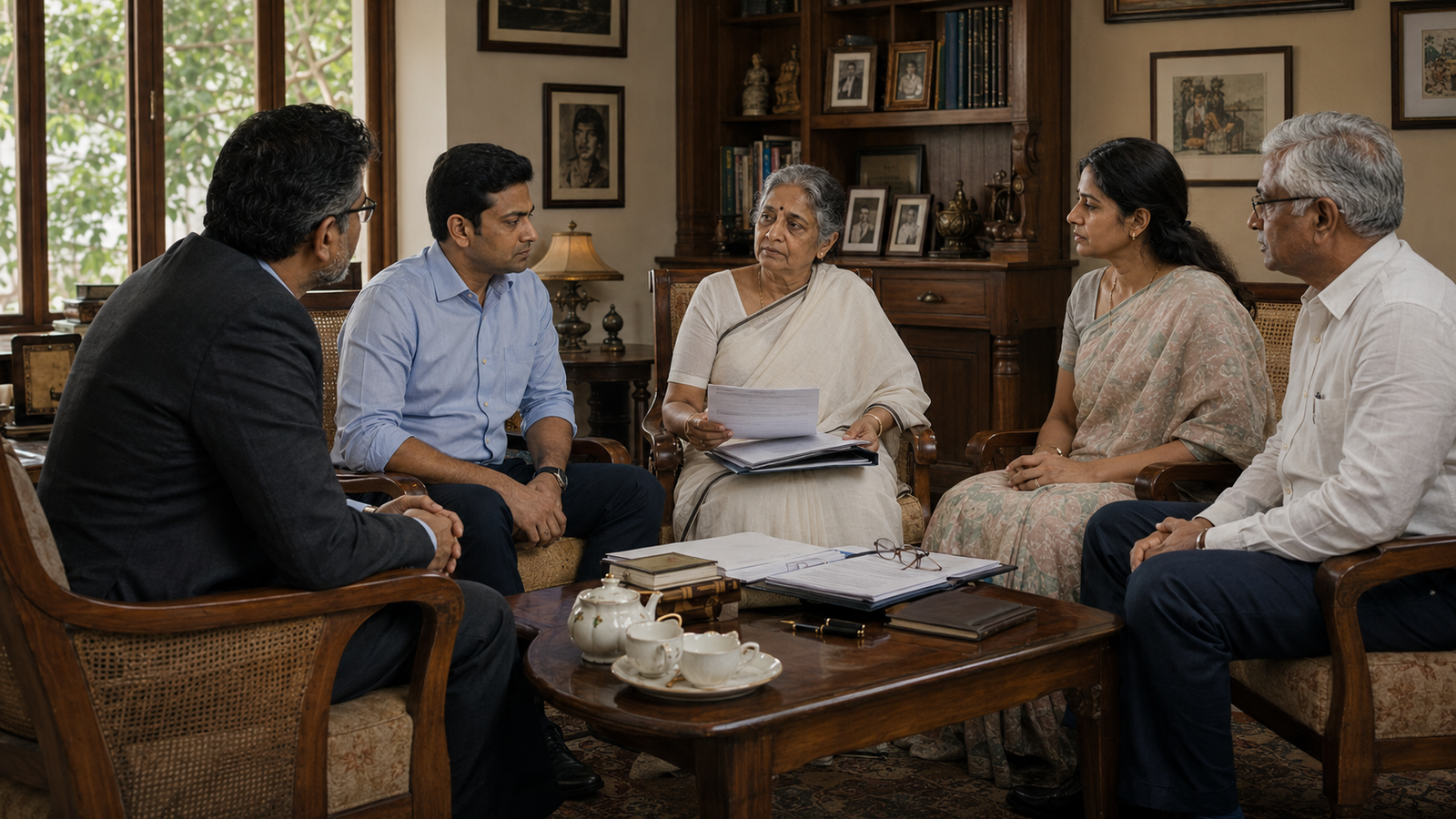
In the fifth week the four of them sit in one room at the house. Divya is not in it, and was told why beforehand, in person, by him and not by the family. Nandhini speaks first, which is the only arrangement under which the one who came from furthest says anything at all. She says she was in that house thirteen hours before her father was, and that since the cremation nobody has telephoned her about any of it, and that she is not saying it against her brother. Karthik says he telephoned her before he telephoned his own house. Both are true and that room held both of them. Then the question, put to each in turn. What they thought he had believed was going to happen to that company.
Then it came to her, and the room was not expecting that. She said she did not know, and that nobody had ever told her anything about it, and that it had suited her perfectly well for forty-two years. Then she said she had signed fourteen things since March and had not read one of them, and that she would like, once, to know what she was signing. Nobody filled the silence after it. Then Sundaramoorthy, who had deferred every item since March, said she was entitled to that.
What she signed, having read it
The bank mandate first. Any two of three, and above a limit one of the two must be the chairman. It is the shortest document in the file, and it is why eleven hundred people will not be paid late again. The chairmanship and the managing directorship separated. Karthik managing director. Sundaramoorthy chairman for three years, the job written down rather than honorary: the two customers, thirty-one years in one man's hands, handed to Karthik against dates, one at a time. He asked for four years. He was given three and did not argue. A dividend policy, with a formula and a date, so that what reaches a woman of sixty-three is not settled each year by her son. Then four wills. Hers runs to two pages. She wrote what she wanted in the hard-bound book first, and had it typed.
Two decades in institutional finance sits behind the instruments, at HSBC India and then as a founding-team Director of the family office practice at ASK Wealth Advisors. A doctorate in clinical psychology sits behind the rest, and both halves are done by one person in the same room. By the fourth board meeting he was marking up an agenda somebody else had written. By the seventh he had not seen it before he walked in.
December
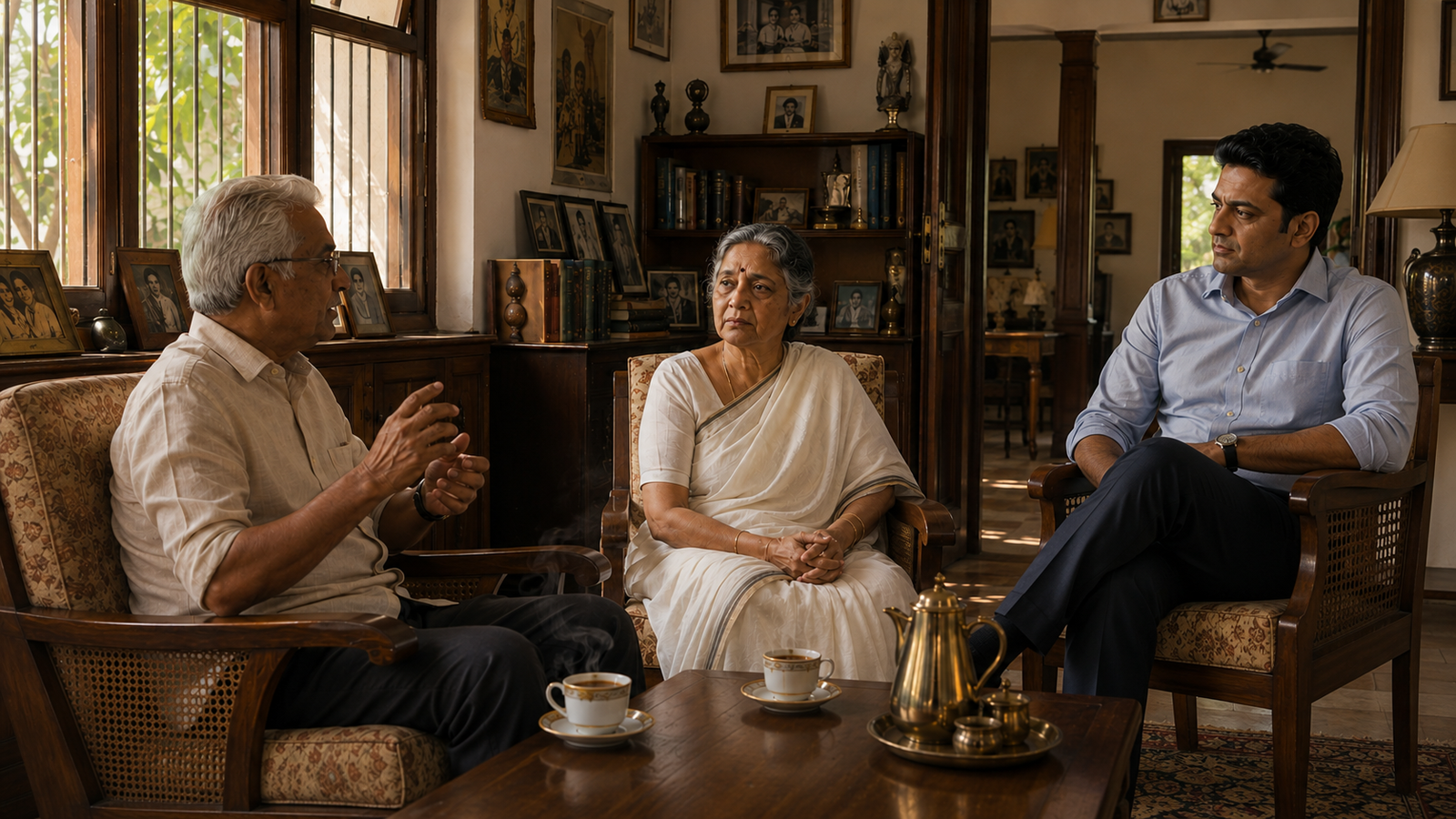
Raghavan stopped at the house on his way back from a wedding at Tiruppur. She asked him what her husband had been like in 1986. A customer at Hosur rejected a whole batch, he told her, and he could not pay for the castings he had taken, and he drove down here to say it to a man's face instead of telephoning. Velusamy did not lend him money. He sent his own foundry supervisor to Hosur for nine weeks. The man slept in the shed and ate what Raghavan ate, and the batch after that passed. Raghavan said the man's name. He is in Karamadai now, eighty-one, and his son brings him to Hosur once a year. She had been married to that man for forty-two years and had never heard any of it.
Karthik was in the doorway and did not come in. Then he came in and sat on the arm of the chair nearest the door, the way he used to when he was eleven. Somebody brought coffee in and went out again, and none of the three of them touched it. Raghavan told them the rest of it.