The Daughter in Law
Thirty four years in the house, and no one has ever been unkind to her. That is the difficulty.
The caterer on her phone
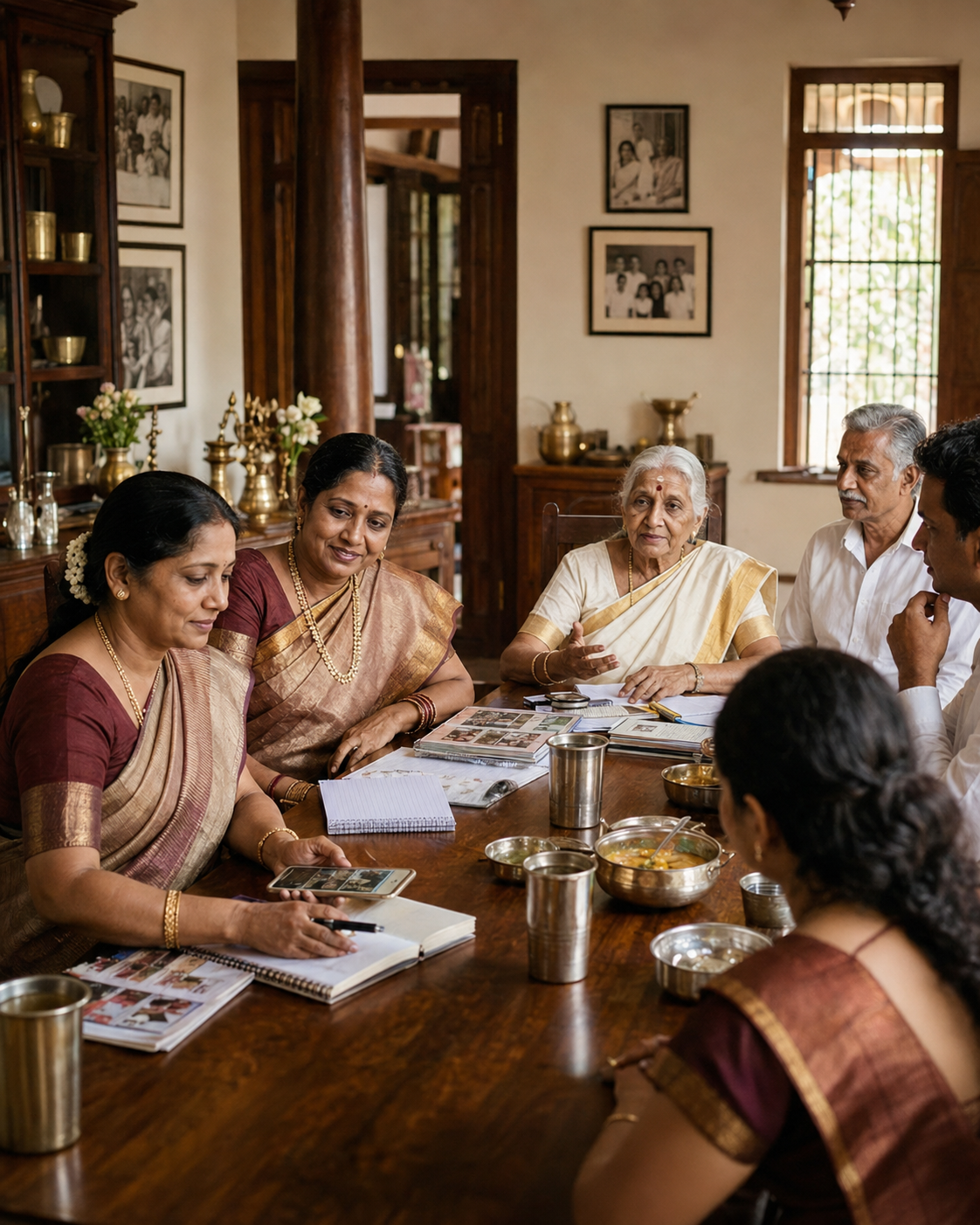
At the table where they are fixing the wedding, she is the one who has the caterer’s number. She had started weeks ago. She asked around, quietly, the way she does everything, and it was Padma — her closest friend, thirty years now — who said use the man we had for Ganesh’s wedding, you were there, you ate that sappadu. She had been there. She remembered the food exactly. So she called him. She drove out one afternoon on her own, sat in his small tasting room, went through the whole menu, and loved it — the payasam especially, which she wrote a note about in her own hand. She settled the quote and kept it in a folder on her phone against exactly this afternoon.
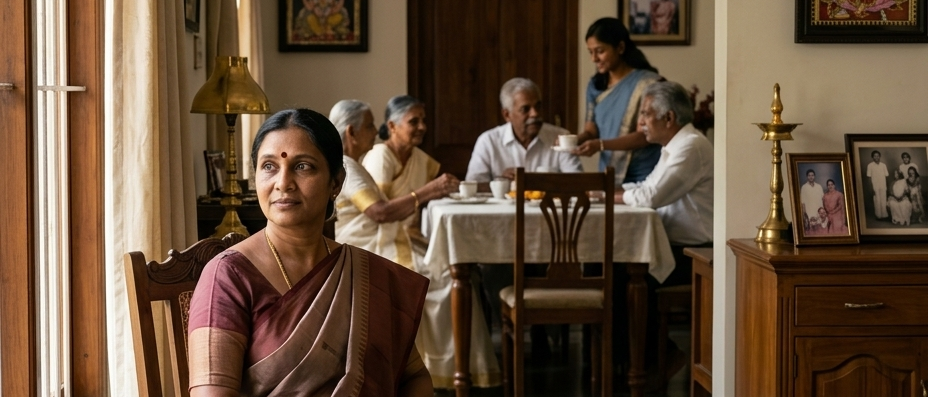
When it comes up she has it ready and offers it, quietly, to her anni — her husband’s elder brother’s wife — who runs these things. Her anni smiles at the photos, says he looks nice, and turns to her Maami to choose between this man and the Chettinad man. Her mother-in-law chooses the Chettinad man. Of course she does. He has fed three of their weddings. She puts the phone away. She tasted that food. She drove out there alone and knew, the way she knows things, that it was better. And she says nothing, because there is nothing to say. A caterer is a caterer. It would be mad to mind, and she does not mind. She will not let herself mind. She refills the tumblers and asks if anyone wants more rasam.
Thirty four years
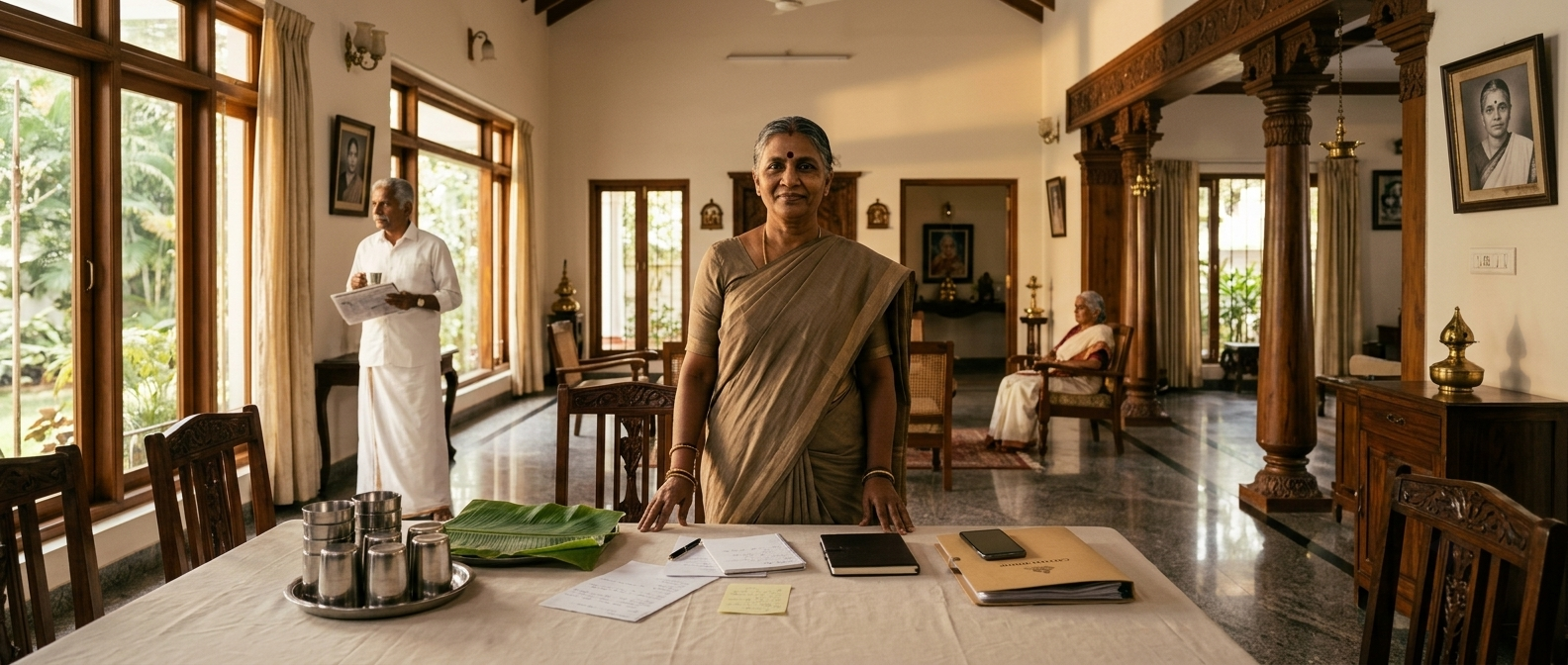
She came into this house at twenty-one. She is fifty-five now, and in all that time no one has been unkind to her. She needs to be exact about that. It is the truth, and it is the whole trouble. Her Maami was gentle with her when she was new and frightened. The house was glad when Meera was born. When her own father died, Raghavan sent the plane himself. Her co-sister has loved her for thirty-four years. The two of them married to two brothers, which should have made them equals, and did not. The seniority between the men settled over the women too, quietly, and no one ever decided it. So the love comes down to her the way you love a younger sister: warm, teasing, protective, and never once needing to ask her what she thinks.
There is no scene she could describe. No raised voice, no slight she could name, no door shut in her face. In the bad hours she has gone looking for the one incident, the thing she could hold up and say this, this is what was done to me. There is nothing there. The nothing is heavier than anything would have been. She is Shankar’s wife. She has been Shankar’s wife for thirty-four years, and the sentence has never grown a second half.
What Shankar carries
Her husband is sixty-two, and he has been the younger brother every day of it. When their father died the business was two lathes and a debt. Raghavan slept in the shed and built the thing, and Shankar was beside him for every hour, and beside him is where he stayed. He signs where he is asked. He is honestly glad when his brother is praised. In thirty-four years she has never once seen him ask what his own share was — because to ask is to admit there is a question, and Shankar will not permit the question. Not even to her.
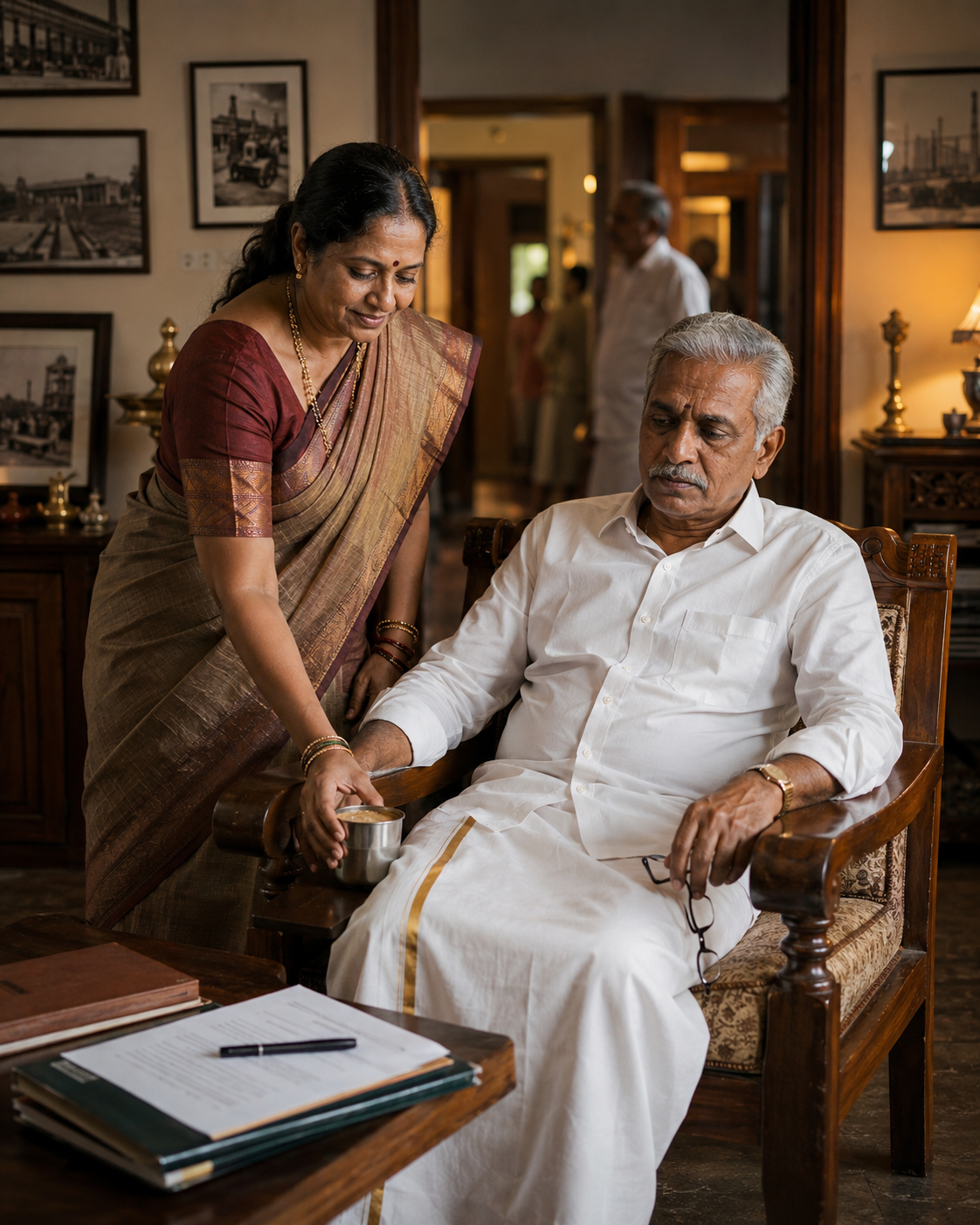
A partition is coming. No one has said it at the table, but she knows it the way she knows the season is turning. Raghavan will decide it alone, in his own time. Shankar will take whatever it is and thank him. And she will sit beside her husband while he loses a thing he will never name, and hand him his coffee, and keep her own mouth shut, because that silence is the last dignity he has, and she loves him too much to take it by speaking.
The daughter who will not come
They have one child. Meera is in Seattle, and she is not coming home. She did her master’s there and stayed. She is happy. She calls on Sundays. She has never pretended to want the business, and no one should ask her to. Shankar wants her back so badly he cannot say the word. He says it as the aunts are asking after you, as the cold must trouble your chest, as a house is a strange thing to keep for no one. Her mother carries these across, softened. So she stands in the middle of the two people she loves most, and she will not push. She will not spend her daughter’s one life patching a wound in her husband’s. She will not tell her husband the girl is not coming. She holds both true things, one in each hand, every day, and tells neither of them the other. No one asked her to carry this. No one will ever see her do it.
The arithmetic that will not come out

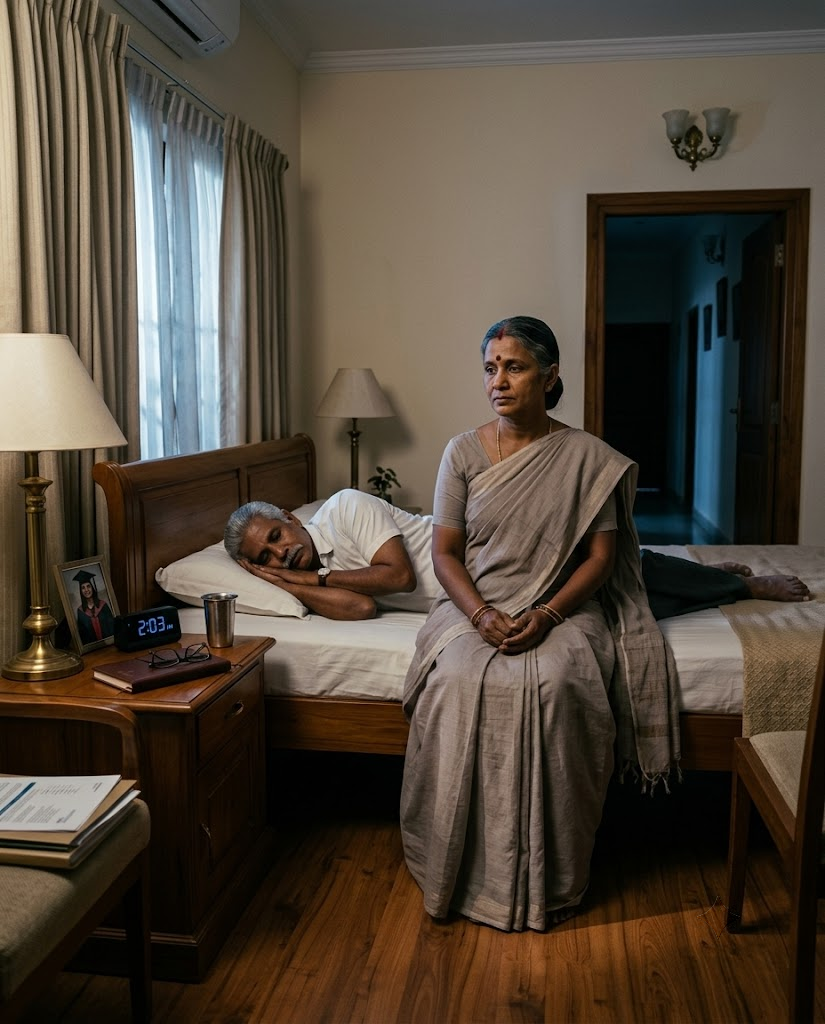
This is the thing that keeps her awake, and it is not anger. It is that none of it solves. The partition is coming and she cannot see its shape. The girl is not returning and cannot be made to. The husband is losing his place and will not grieve it anywhere she can reach. She lies in the dark and turns the three of them over, and over, and there is no way to set them down that comes out right. And there is no one beside her to be awake with. The one man who knows every fact of it decided, long ago, to feel none of it out loud. She is not lonely in the day. It is at two in the morning that she understands she has been alone a long time. And she cannot even be angry, because there is no one to be angry at. Her Maami is the elder woman; that is how a house is arranged, not a cruelty. The kitchen is her co-sister’s, because that co-sister married the elder son, and she runs it with real kindness. Raghavan built the business, so it is his to divide — arithmetic, not a wrong. Shankar loves his brother. Meera loves her mother. Every last one of them is good, and means her nothing but well. That is the part with no handle on it. A cruel house she could have left, or fought, or at least named. A kind one she can only go on living inside, holding a thing that has no name, and so has no door, and so has no end.
If no one has ever been unkind to her, what exactly is wrong
Was nothing ever done to her — or was she only, in thirty-four years, never once asked?
The lamp in the kitchen
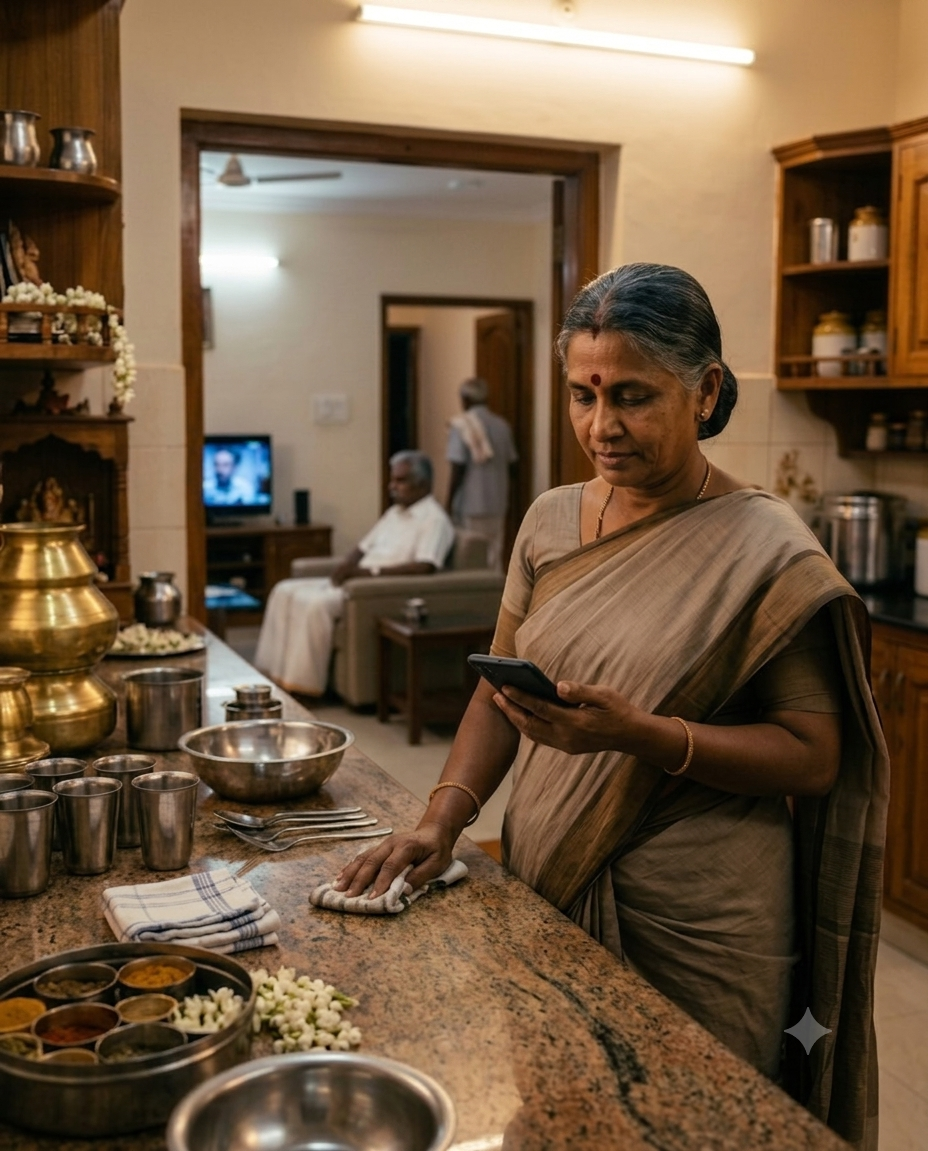
The house empties after the wedding is fixed. The cars go, her Maami is helped to her room, her co-sister’s people leave, and at last it is only the two of them, the servants, and the smell of the day’s cooking gone cold. Shankar sits with the television on and not watching it. She brings his coffee the way he likes it and sets it by his hand. It went well, he says. It did, she says. She can see the partition sitting behind his eyes, and she does not ask. He would say it was nothing, and then he would have lied to her in his own house at the end of a long day, and she will not make him do that. She goes into the kitchen to put the last things away. Her phone is on the counter, the caterer’s folder still open where she left it — the photos, the prices, the little note in her own hand that the payasam was good. She looks at it.
And she thinks, the way you think a thing you have never let yourself say, that in this whole full house she has kept for thirty-four years, there is not one person she could tell. Not her Maami. Not her anni. Not Shankar. Not Meera. To tell any of them would be to ask them to have done something wrong, and not one of them ever did. It would have to be someone who is not in the house. She closes the folder. She wipes the counter, turns off the lamp, and goes back to sit with her husband in the light of the thing he is not watching.