
Succession
The date is agreed. The Monday after has not been discussed.
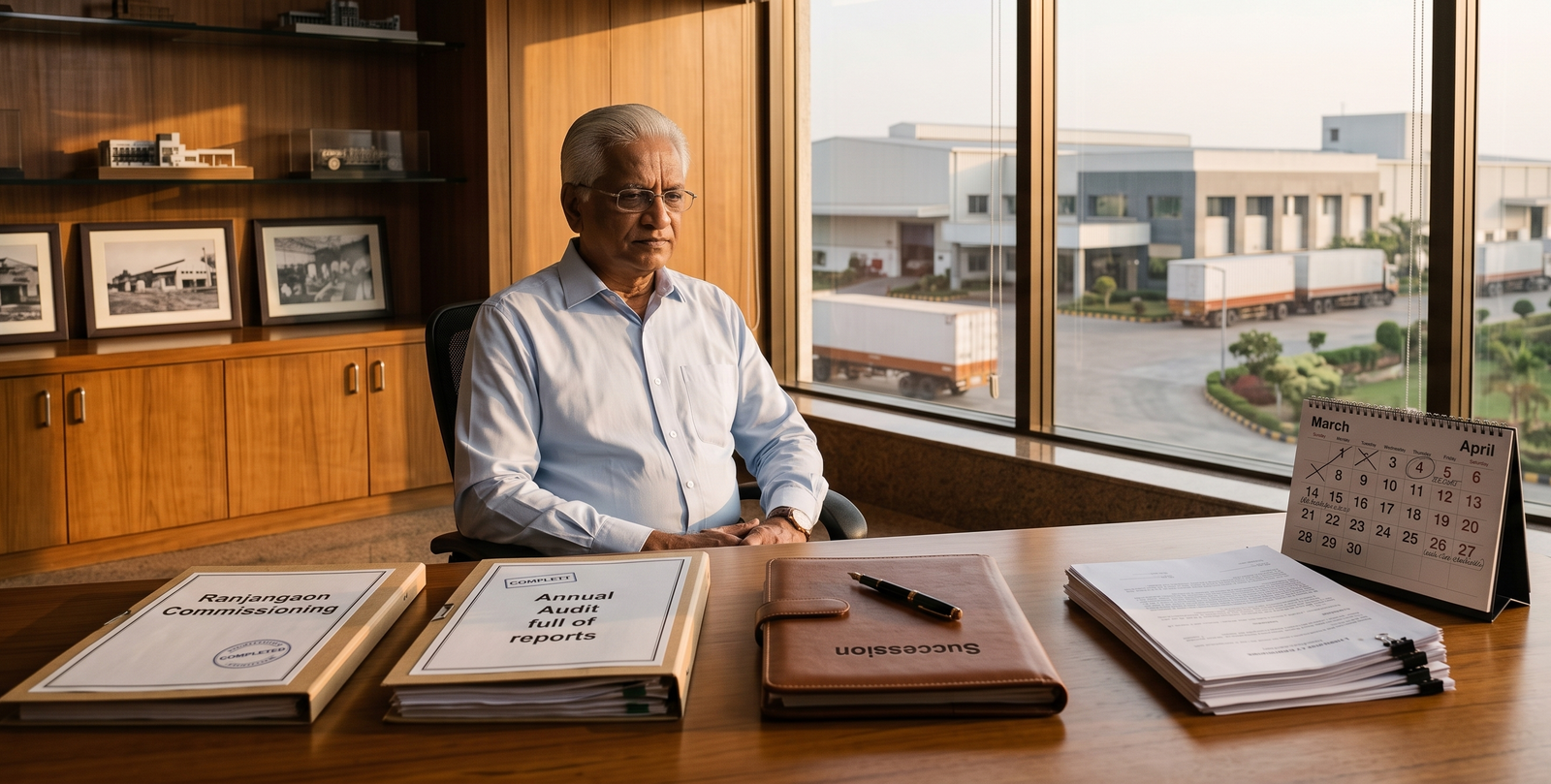
The date has moved twice
It was going to be March. Then it made sense to wait until Ranjangaon was commissioned, because you hand over a settled thing, not a half-built one. Then the audit. Nobody argued either time. Nobody in the house has ever said no to it, which is why it keeps moving. What is difficult about family business succession is not the transfer. A group with six plants, three businesses and eight thousand crore a year going through it has lawyers who can move the shares in a fortnight. They will, on the day somebody answers nine questions that have not been asked out loud.
Nine questions nobody has put
Who runs auto components. Whether the two newer businesses stay under one person or get separated on purpose. Whether his daughter's vertical stays a division or becomes a company with its own board and her name on the filing. What his brother's branch holds, shares or a seat or both, and whether that is written down or understood. Whether the holding company becomes the place the family sits while the operating boards become the place the professionals sit, or whether that line stays where it is now, which is nowhere. What a share is worth when it moves inside the family, and who decides it. Whether that formula is agreed now, while everybody is still friendly, or argued over later by people not currently in the argument. What happens to the two customer relationships that have been personal for twenty-two years, and which of them does not survive being handed on. What his own role is called afterwards, and whether there is a date on it. Each ends in an instrument, and the instrument takes a week. Getting to it takes months, because the wrong answer to any of them costs a brother, and there is no forum in the group where that can be said.
He sees them one at a time
This part is on no plan and no invoice line, and it is the part that decides whether the date holds. Before anything is drawn, Praveen Saanker sits with each of them alone. Four months, sometimes six. Several conversations each, and some of them run for hours. Nobody sits with a man a fourth time unless the fourth conversation is expected to hold what the first three did not. And not only the ones with shares. The people with no standing at all are the ones who move a date without ever being in the meeting.
His daughter has been in the business fifteen years and has been asked her view on the succession twice, both times in a car, on the way to something else. She talks for two hours and apologises for it at the end. His son-in-law has run a division for nine years and has never been asked what he would like to run next. He answers with the door open, carefully, in the voice he uses for the buyer's audit. Then he gets up, closes the door, and starts again. His brother is sixty-two and has spent forty years in the second chair. Twice in the first hour he says that whatever his brother decides will be correct. The third time, he says something else, and then looks at the door. His wife is asked what she wants and answers about her husband. That he is not sleeping. That he has stopped saying anything at dinner and she cannot tell whether that is the business or her. She is asked again, about herself. There is a pause long enough to hear the fan, and she says nobody has put it to her in that direction before. She has lived in that house for forty-one years. None of it is reported back. Nobody is told what anyone else said, then or afterwards. What comes out is that one person now knows where the disagreements actually sit, and they are almost never the ones on the agenda. Which is why the first room is arranged before a word is spoken in it.
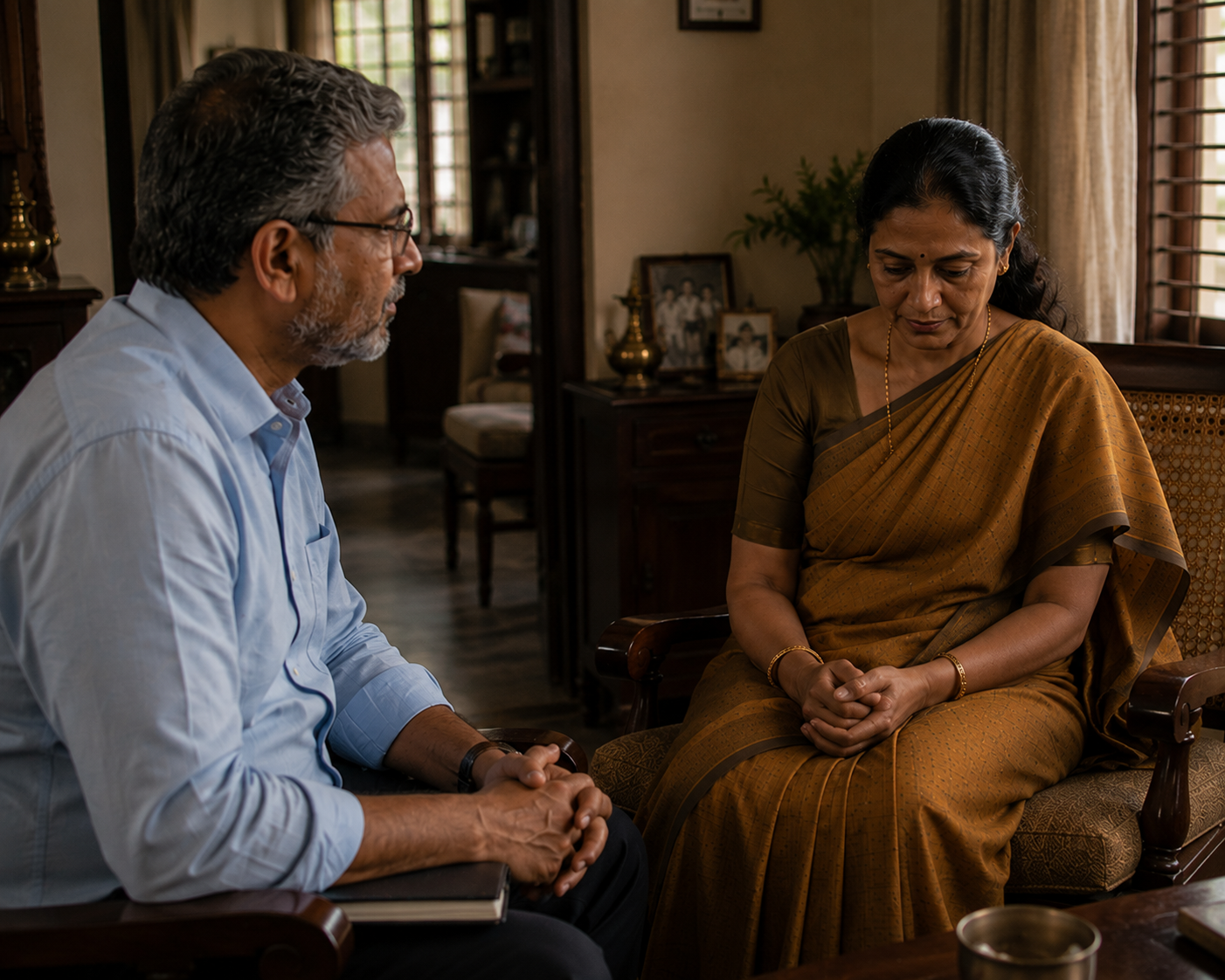
Where people sit

A Saturday, in the house, not the office. Tea comes at eleven and nobody drinks it. Where each person sits is decided beforehand, and not by seniority. His mother's chair is carried in and set beside her son, not down at the end with the grandchildren. The son-in-law is at the table and not against the wall, because a man against the wall is a witness, and the family will read him that way for the next nine years. The daughter is not put beside her husband. A woman seated beside her husband gets spoken to through him, and it takes the room about two hours to stop doing it. The order of speaking is fixed in advance too. Youngest first is not a courtesy. It is the only arrangement under which the youngest says anything at all.
So the son speaks first. Thirty-four, on the floor since he was nineteen, four minutes on the Hubli line and what he would do with it. It is the first time most of the people in that room have heard him say what he wants rather than what he has done. His brother looks at the table while the boy talks. His brother's wife, who came into this house at twenty-one, is watching the mother's face and not the boy's. A phone goes somewhere and is silenced twice. His daughter has a folded page in her hand that she does not open. He says nothing for the first hour. Nobody has asked him to. What comes out of the room is not agreement. It is that the thing has been said once, in front of everyone, by the person it belongs to.
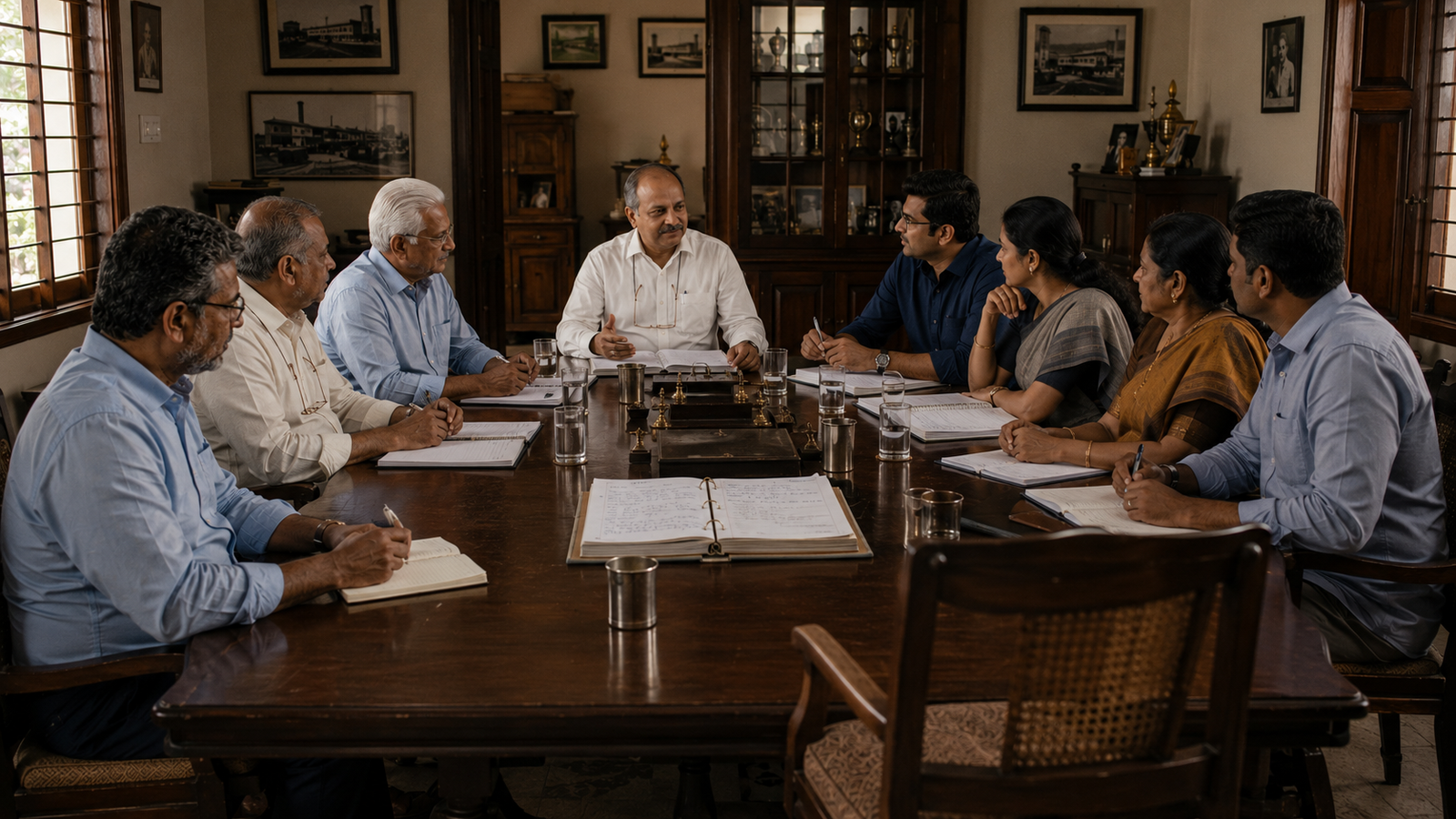
Four meetings, then he stops coming
He does not chair the council. The family chairs it, and he sits to the side of whoever does. He writes the first agenda on a pad and hands it over. By the third meeting the family writes it and he marks it up. By the sixth he has not seen it before he walks in. The minutes are the discipline he does not let go of. A decision recorded with a name and a date is a decision. A decision recorded as this was discussed gets had again in nine months, with different tempers.
Somewhere in the second or third meeting, somebody walks out. It is usually the one everybody had listed as fine. He does not go after them straight away. He lets the room sit with it for a minute, which is longer than it sounds, and then he goes. He will not say who should run auto components. He has a view and he keeps it, which families find hardest about him in the first two months. The council decides; he holds the process by which it can. Then he stops coming. Four meetings, sometimes six, then once a year, then a phone call in March. By then the thing holding it together is not him. It is on paper.
What gets written down
The council owns a defined list and nothing outside it: capital above a threshold, the entry of family members into the business, the terms on which they leave, pay for the ones who work, dividends for the ones who do not. Everything else stays with the board. Membership settled by branch before anyone sits. Fixed dates. Underneath it, the ordinary machinery. The holding company and what it is actually for. A formula for what a share is worth when it moves inside the family. A buy-sell, so that wanting out stops being a betrayal and becomes a clause. Two independent directors whose real function is to be people a brother can disagree with in public. The charter and the shareholders' agreement come last, after the decisions exist, because until then there is nothing for a document to record.
The structural half and the human half are done by one person in the same room, which is the method. Over two decades in institutional finance sits behind the first: Senior Vice President at HSBC India, then a founding-team Director of the family office practice at ASK Wealth Advisors. A doctorate in clinical psychology from the University of Canterbury sits behind the second. Not a handover to a colleague after the interesting part.
The Monday
The date does not slip because the legal work is hard. He has been asked what he plans to do afterwards perhaps forty times in two years. At weddings, by his own auditor, by a man at a CII dinner who meant nothing by it. He has answered pleasantly every time, which is not the same as having an answer, though it has sounded like one from the outside for about two years now. That is the half that gets worked first, and it is workable. What the week is for. What he is answerable for once he is not answerable for the number. Whether it is the chairmanship with an end date on it, the board he keeps declining, the trust, the land, or the thing he put down at thirty-one and has not mentioned since.
The tradition he grew up inside already holds that there is a stage that comes after the building, and that it is not a withdrawal from the world but a change in what a man is responsible for. Do this part and the date holds. Skip it and it moves twice more and then stops being mentioned, and the thing waits for a health event to decide it.
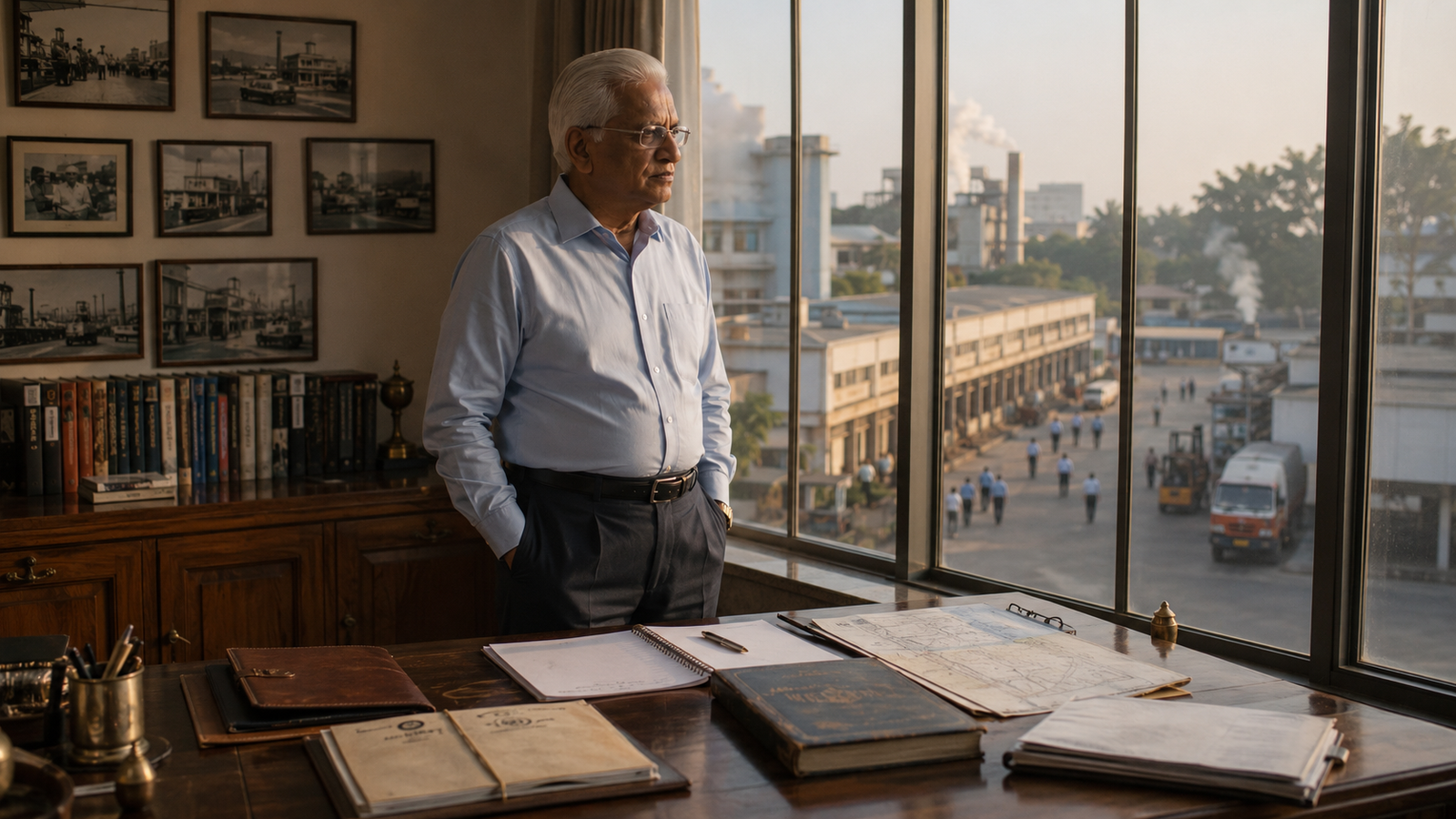
What Bhupen Shah talks about for forty minutes
Rajkot. Forgings. They met in 1979 at a components exhibition in Bombay, both of them under thirty, both with one machine and a loan against a house. He handed over at sixty-eight, four years ago. He rings about once a month, for no reason at all. A school he funds and admits he funds badly. A mango graft that has failed twice, described at a length nobody requested. His grandson's cricket, including an lbw he is still angry about. Forty minutes, and he never asks how the business is. Neither of them has ever needed to establish which of them is richer. He does not check the founder's face while he talks, which is a thing men in this position learn to do and he has stopped doing. Four years ago he had three sons, two of them not speaking, and a legal notice drafted and never filed. Everybody assumed that family was finished. His middle son runs it now. Bhupen goes in on Tuesdays, because he likes Tuesdays.
April
It was announced at Hosur, on the floor, and it took about a minute. He read it off a card. Then he went up to his room on the good floor, which is still his, and answered his email.