The Heir
He has never been hired. Never been rejected. He is thirty-four.
Fifty one minutes
The Hosur plant is forty minutes from the office and he drives it himself.
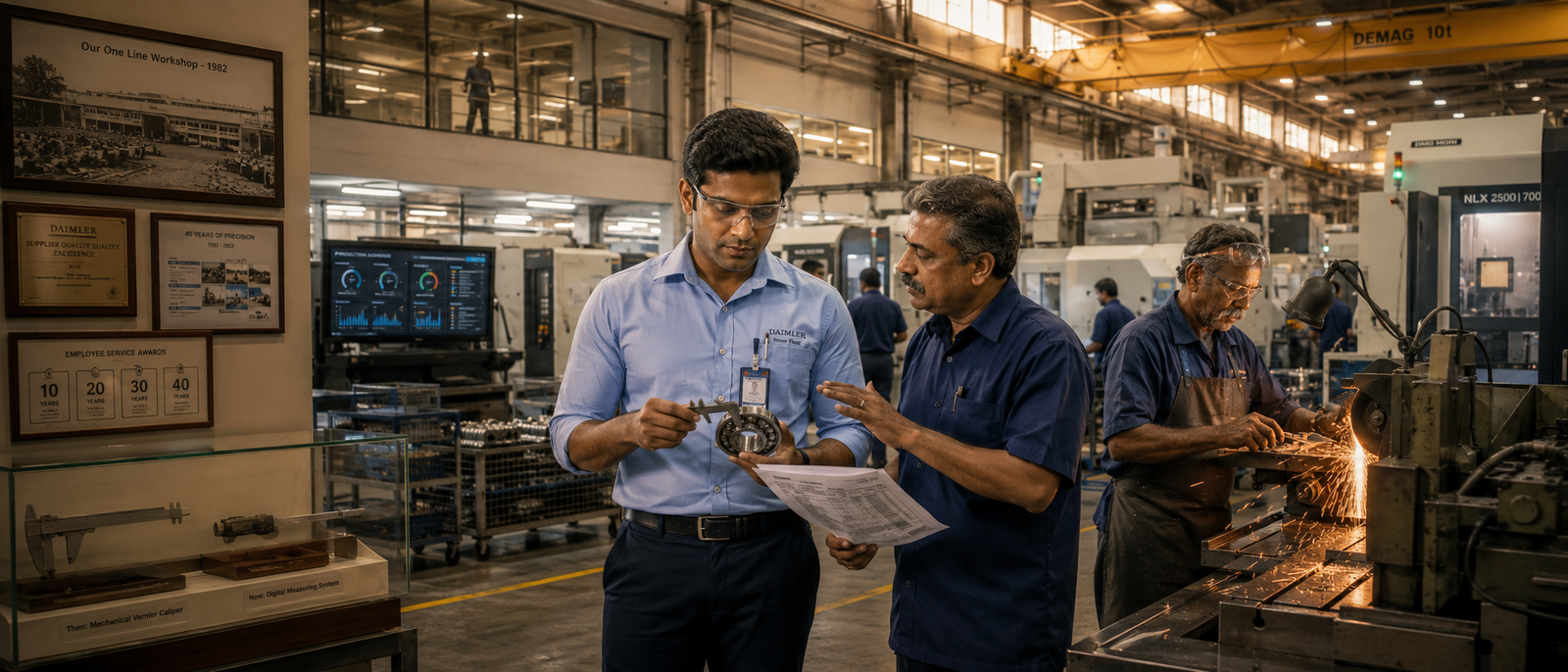
Four bearing caps out of tolerance in a batch of two hundred. Nothing — and the kind of nothing that becomes a Daimler audit finding in March. The plant head, Reddy, gives his theory about the coolant with both hands moving, and there is a thin fear under it: a boy in second year at VIT, a loan against the house, and the private knowledge that a finding like this ends men like Reddy while the men above them keep their cars. He knew it was the wheel dresser before Reddy finished. Nine seconds — the pitch of the line through the wall, off by a fraction only a boy raised on that floor would catch.
He lets Reddy finish. Then he turns to Murugan, the line supervisor, who has been studying his own shoes because he knew twenty minutes ago and could not say it over the plant head’s head. Murugan, he says. What do you think. Murugan looks up, and something crosses the man’s face — the careful hope of someone who has been right before and been made to pay for saying it too soon. The wheel dresser, sir. Quietly. They pull it. The batch runs clean. And for a moment Murugan cannot keep it off his face; he turns half to the machine, so the sir will not see a grown man glad as a boy at being asked. He sees it anyway. He signs two forms, asks Reddy about the boy at VIT, and walks into the four o’clock heat, tired in the weightless way of a man who has fixed a thing that was never going to beat him. The gate log says fifty-one minutes.
Four microns
On the way to the car he stops at the third bay, where nothing is wrong.
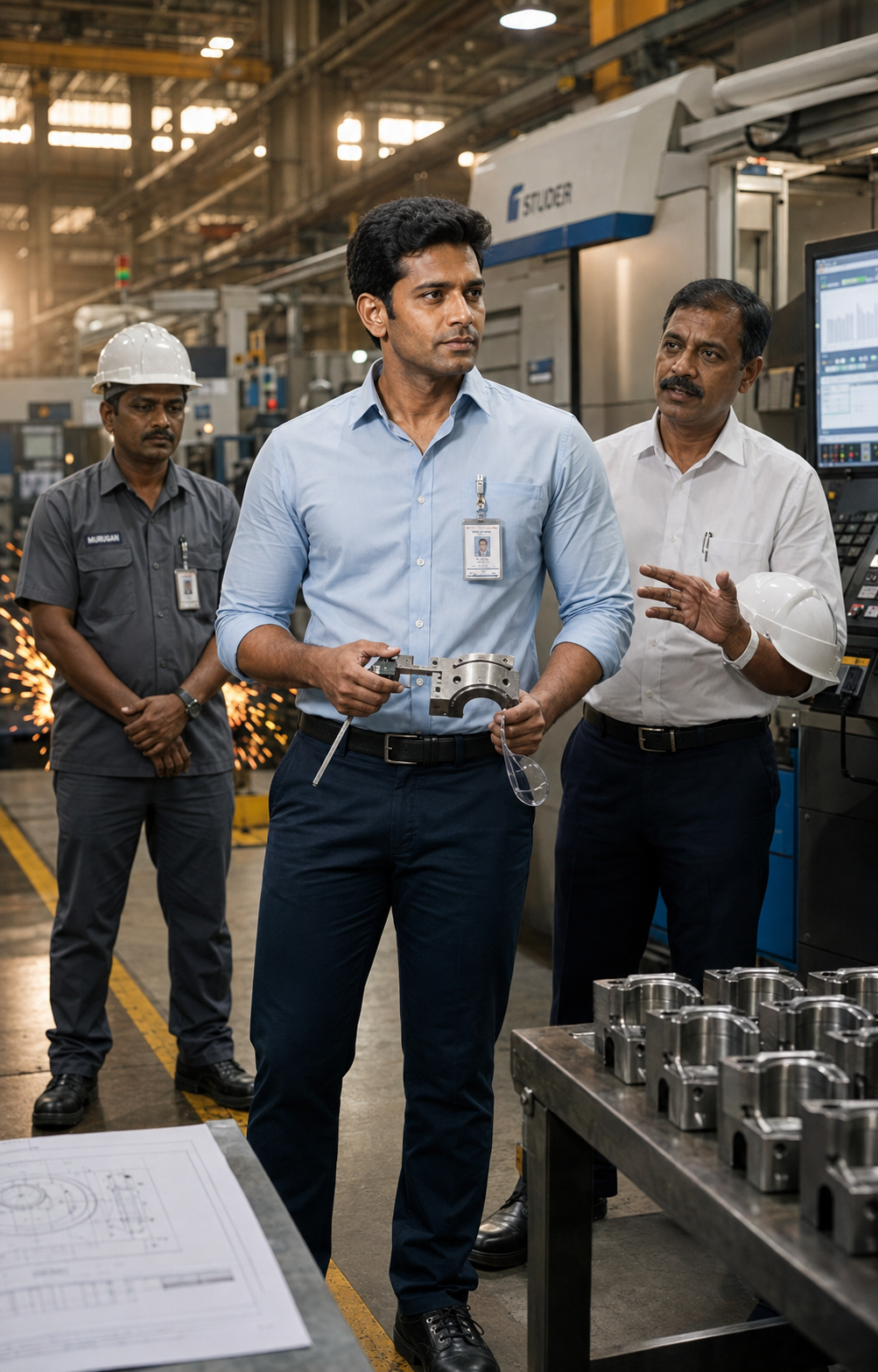
An old man is at the grinder there — Thomas, who came down from Kerala thirty years ago, on this floor since before him, since the years his father still slept on site. Thomas looks up, and his face does what all their faces do: it straightens, it warms, it offers itself. He nods and returns to the wheel, and there is pride in his shoulders now, in the clean bright arc of sparks he throws — a man showing the young master that the work is in good hands. He watches, with nothing in his own hands. He was nine when his father first brought him here on a Saturday, closed his small fingers around a calliper, let him measure a bearing cap. Out by four microns, his father said, and laughed — big, delighted, the laugh of a man whose son had just touched the thing he loved — and showed him again, their two heads bent over the steel.
There is a shed at the back of this building. His father slept in it for two years, when the plant was one line and the orders were not sure to come. The old men still tell it, tender and rough at once — the cot, the watchman who took the owner for a thief, the tea at four in the morning that was mostly not tea. They tell it with love. Two years of a man’s nights, so this boy would never sleep one in such a place. Thomas is still throwing his bright arc, still glad to be watched. Somebody is calling him. There is a four o’clock. He does not move yet.

What Ravi knows
Ravi Menon was in his class from the fourth standard, and Ravi at a wedding is a force of nature.
He found him on the steps outside, thinner, a drink going warm in his hand, already grinning. Machaa. The grin of a man with nothing left to protect — because Ravi had lost all of it: his own company, his own idea, four years, thirty people, his money and a slab of his father’s, gone down in one bad-monsoon year. Eleven months without answering his phone. His father silent for nine of them. And here he was, laughing. He turned the phone around — a truck driver’s small daughter in a paper crown. This fellow’s kid, he sends me one every week. Forty-one drivers call Ravi directly. A man in Erode will deal with no one else, once drove ninety minutes just to press a tiffin of his wife’s cooking into Ravi’s hands, and drove back.
What a driver loses on an empty return leg is not money, he said, leaning in, urgent, needing him to get this one thing — it is his day, machaa, a whole day of his one life thrown out on the road, and a man will do anything not to lose his day. He talked twenty minutes and never once checked the other man’s face to see if he was bored, because Ravi was lit from the inside now and no longer needed anyone to hold the light for him. I know what I’m for now. He said it looking down at the phone, thumbing a load onto a lorry, the way another man might mention the time. Then he was up — five o’clock start, a cabin waiting — clapped him once on the shoulder, warm, and went back inside, to the front, to the seat near the family.
The record

Two thousand one hundred crores in turnover last year. Four plants. Eleven hundred people.
The Daimler programme was his — the audits, the line torn down and rebuilt twice to hold a tolerance most men could not see — and it cleared. The distribution rework was his call and the numbers have held. Two years on the floor at Hosur before any of it, properly, no shortcuts. Fourteen years, and he has never lost.
He has also never applied for a job. Never sat across from a person with no reason on earth to be kind. Never once been told no by someone who could afford to say it. So there is nothing to weigh the fourteen years against. Murugan was right this afternoon — and he would have been right if his own name were different, and there is no experiment left that could separate the two. His father is seventy now and comes in three days a week. It used to be five. Nobody said a word about the change. It just began, and then it was how things were.
The question he has never said out loud
Does he belong to this — or does it belong to him?
Eleven months
He has turned that question over for two years. Not the question. The eleven months.
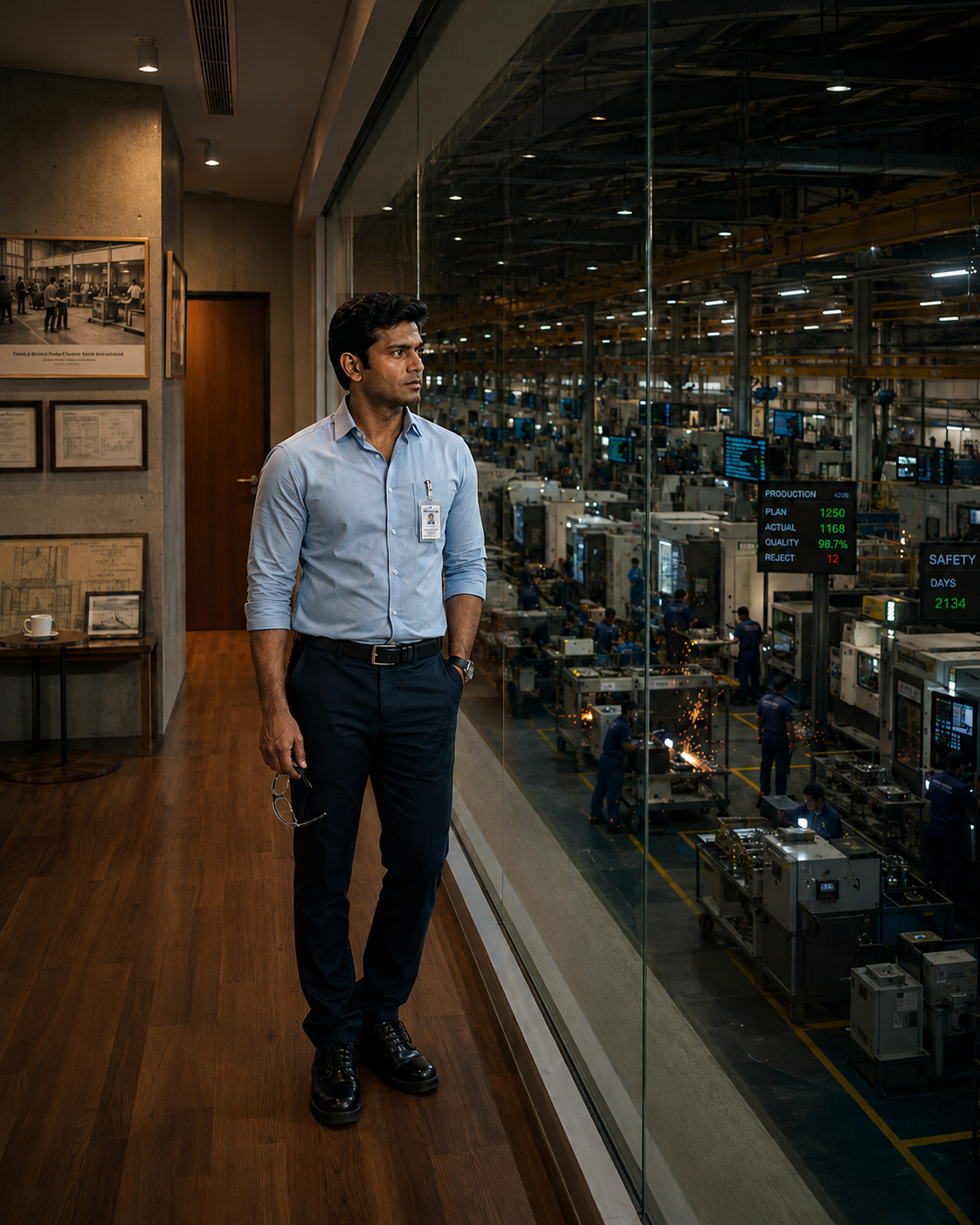
The going dark — nobody calling, nothing running, no floor to walk onto at eight in the morning whether he willed it or not. Ravi had been allowed to fall all the way to the bottom, where a man meets the thing he is and finds out, alone, what he is for. He has never had eleven months. He has never had eleven days. There has not been one hour since he was nineteen when the thing was not there — needing him, running, magnificent, his father’s two years of nights folded into every beam of it. He would not swap it. He wants to be very clear on this. There is no one he is being clear to. He puts the car in gear. There is a four o’clock, and he is not going to be late for it, and he never has been.