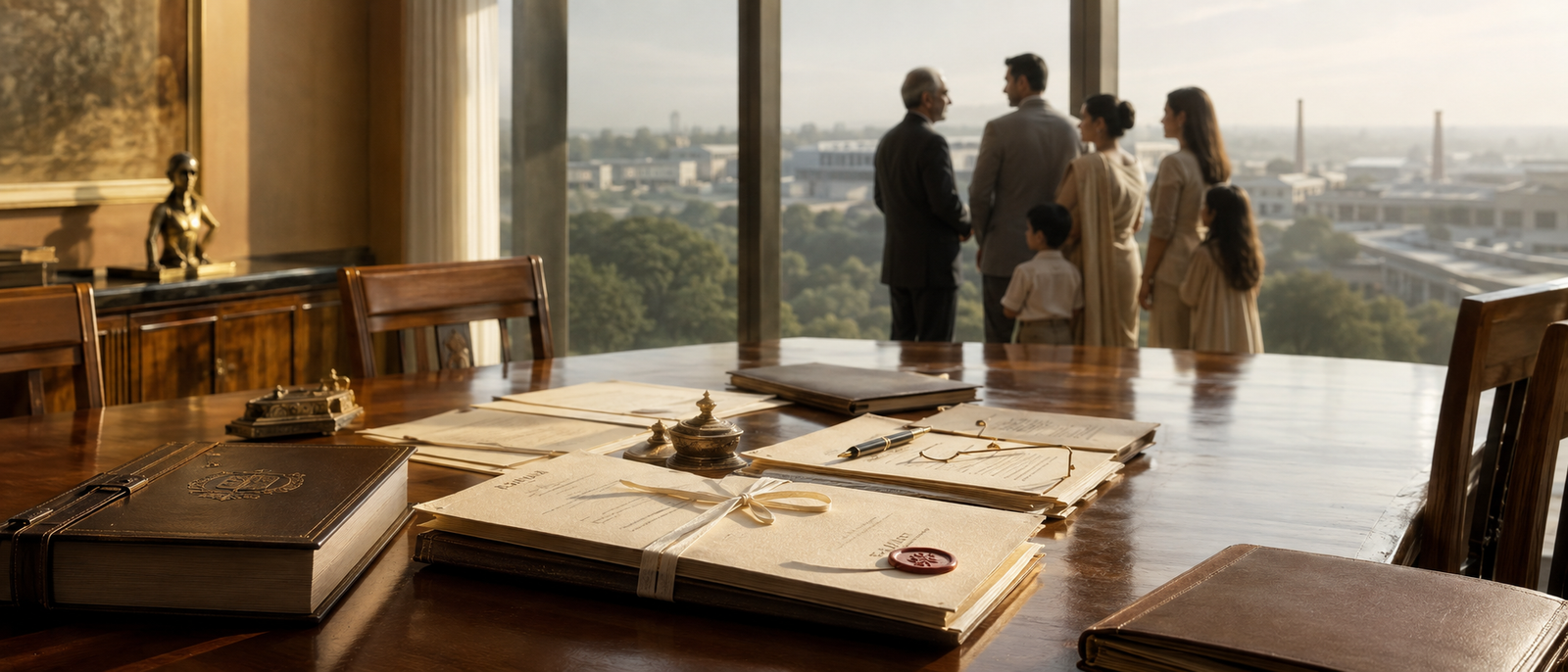
Most Indian business families have no will. The ones that do usually wrote it before two of the current businesses existed. Estate planning is the work of deciding what happens to what you own, and recording it where it will hold. In India that means a will, sometimes a private trust, the nominations on financial accounts, and a power of attorney in case of incapacity. All of it produces answers. The difficulty is that those answers are delivered on the single day when nobody can ask a question about them. What follows covers the instruments, what they cannot decide, and why the order matters more than the drafting.
What estate planning in India covers
A will is the base. It sets out who receives what, and needs a sound mind, a signature and two witnesses. For immovable property in Chennai, Mumbai and Kolkata the executor may still need probate, and a bank may ask for a succession certificate first. Nominations are the part most people get wrong. A nominee on a bank account or a share holding is a custodian rather than an owner, which the Supreme Court confirmed in 2023. A power of attorney is the one families skip. It covers the years before death, when a founder is alive and no longer able to decide. Without it a group can be paralysed by a woman who is still legally in charge and no longer able to sign. India has had no estate duty since 1985, so there is no inheritance tax to plan around. What there is instead is intestacy. Die without a will and personal law divides the estate by formula, whatever anybody intended.
Whether a trust is better than a will
A will takes effect on death and can be rewritten until then. Nothing moves while the person is alive. A private trust, under the Indian Trusts Act of 1882, operates from the day it is created. Assets leave the personal estate, which is why families use one when a business carries risk or a beneficiary is a minor. The trade is control against certainty, and which one suits a family depends on its assets and its personal law. That decision belongs with a lawyer who has read both.
What the document cannot answer
It says who receives the shares. It does not say who runs the company on the Monday after. That may be the son who has been in the business twelve years, or the daughter nobody thought to ask. It can divide a business between three children in equal parts. It cannot make three people able to work together, and equal parts is often the instruction that guarantees they will not. It fixes a value for tax. It does not settle what a share is worth inside the family. That number is adjusted by who worked in the business and who did not.
Those are the four questions succession turns on, and no instrument reaches any of them.
Where estate planning fails in a business family
The commonest fault is a will nobody cross-checked. It leaves shares to one child while the shareholders' agreement gives the other branch a right of first refusal over the same shares. Both documents are valid and they contradict each other. Then there are the holdings nobody wants to discuss. Shares standing in the names of former employees and distant relatives from an earlier era. Those people die too, and their heirs inherit a claim on something the family thought was closed. And pledged shares. A promoter's holding given to a bank as security does not become unencumbered because a will says who inherits it. An estate plan written without reading the company's own documents produces a clean instruction that cannot be carried out.
The day it is read
A will is a one-way instruction. It arrives days after a funeral, from the only person who could have explained it, and no reply is possible. A dozen people hear the answer at the same moment, from a lawyer none of them chose. The daughter who was left the flat and not the shares cannot ask what that meant. Her uncle, who received the older business, cannot ask whether it was a judgement about him. Nobody explains to the son-in-law why his name was never read out. Everything they were not told, they now supply themselves. Each of them leaves the room with a version, and the versions do not match. This is where families with excellent documents come apart, and the drafting was never the problem. A document had been asked to do the work of a conversation.
The conversation that comes first
The people affected are told while the person deciding is still alive, and told one at a time rather than at a reading. Everyone is included, and not only those holding shares. A wife or a daughter-in-law who first learns the arrangement from a lawyer will never accept it, however fair it is. Objections are heard before anything is drafted, so the will records what was already said out loud rather than announcing it. Done in that order, the document has nothing left to do except hold. Getting there usually involves someone from outside, who is neither an employee nor a relative. Why that works when the family cannot manage it alone is set out at when the family cannot speak.