
Governance
Everyone knows the rules. Nobody wrote them down.
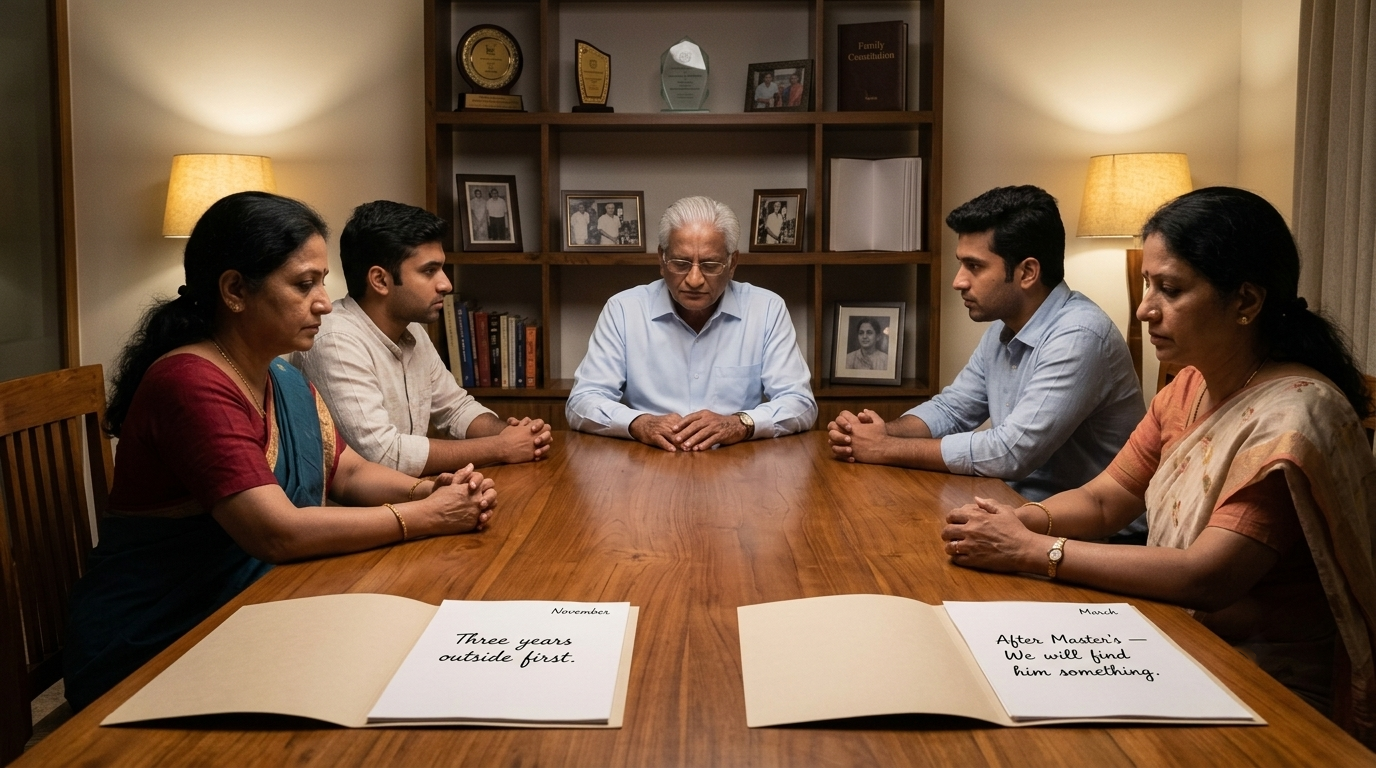
He said yes in March and no in November
In March he was asked whether his wife's brother's boy could come in after the master's, and he said yes, we will find him something. In November he was asked the same about another boy in the family and he said three years outside first, a real job, then we will see. He meant both. Both were sound. Neither is written anywhere, and the two mothers have spoken to each other since. Nobody in that house can say who decides a thing like that, or where it is set down.
The document binds nobody
A family constitution is what gets written when a house has run out of the ability to answer that question one case at a time. It sets out who may join the business and on what terms, who owns what, who decides what, how someone leaves, and what happens to the ones who never come in at all. On its own it is unenforceable. In India it is a moral instrument. It binds nobody, and the families who find this out in year three find it out badly.
Its force comes entirely from what leaves it. A clause that stays in the charter is a sentiment. The same clause written into the Articles, or a shareholders' agreement, or a trust deed, or a will, is a thing a court will look at. Before any of it can be drafted, the family has to agree what it is deciding about. Most have never separated the three things.
Four per cent and a board seat
Ownership is who holds the shares. Management is who runs the plant. Family governance is who decides. The three are not the same people, and in most houses it has never once been said out loud. So a cousin with four per cent, who has run a unit for eleven years, believes he is owed a seat on the board. He is not wrong to think it. Nobody has ever explained the difference, and explaining it now would be rude. His brother's daughter is in Seattle and will not come back. Her dividend is the only thread between her and a company she has never worked a day in. There is no reason for anyone to put it that way, until the year the dividend is cut.

The clause about the man everyone can see

His cousin's son is thirty-one and came in at twenty-four. He is not bad at it. He is not good at it either. Over seven years the plant has arranged itself around that, quietly and without unkindness. Approvals that go a slightly longer way round. A plant head who has never once said anything and never will. He has two daughters. The elder one started school this year.
Everybody is willing to draft the way in. A degree, three to five years outside at a company that did not have to hire you, an interview with someone who is permitted to say no. Those get written in an afternoon and everyone feels the family has been serious. Nobody wants to draft the exit. And the man the exit clause will apply to is sitting in the room while it is drafted, known to every person there and named by none of them. It gets written about nobody in particular. Six years later it reaches someone, and by then there is no person to be angry with. The same is true of the clauses about who married in.

What an in-law is, in writing
Whether a daughter-in-law may hold shares in her own name. Whether a son-in-law may be employed, at what level, and whether he may ever sit on the council. Whether a daughter's children carry anything at all. His own son-in-law has run a division for nine years and there is no sentence in existence that says what he is.
Families draft this part by custom, and custom in a great many houses still quietly assumes that daughters married out. Daughters have been coparceners by birth since 2005, and the Supreme Court settled in Vineeta Sharma that this holds whether or not the father was alive in 2005. A charter that contradicts it is not only an exposure. It is a written record of what the family intended, produced in a room where his daughter was sitting.
The year he overrules it
While he holds control, the document is advisory. Everyone signing it knows that. Its real test comes after him, which is precisely when no one in the house is able to convene a conversation about what it meant. Two things decide whether it survives. The first is how much of it left the room. Provisions that sit in the Articles and the shareholders' agreement bite whether or not anybody feels like honouring them, and they bite because he signed them while he still could. The second is smaller and harder. Early on, something comes up that the document decides against him.
In the second year it is his wife's brother's boy. The one he said yes to in March. The rule is three years outside first, and the boy has done fourteen months, and there is a role opening in April that would suit him. No one argues. They are waiting to see, and every one of them knows that is what they are doing. He says the boy should finish the three years. Then he asks about the receivables, and the meeting moves on. It goes the other way more often. One setting-aside is enough, and afterwards no one says the thing is dead. They are polite about it instead. What outlives him is not the charter. It is whichever parts of it were put somewhere a court can reach.
What has to leave the room and go to a lawyer
Transfer restrictions, into the Articles, because for a private company that is the only place they hold. A shareholders' agreement carrying the buy-sell: the formula agreed while everybody is still friendly, the right of first refusal, and an actual answer to where the money comes from when somebody exercises it. A valuation clause with no funding behind it is not protection. It is a guaranteed argument at the worst available moment, with the tax cost discovered afterwards. Trust deeds and wills that say the same thing the charter says, in the language that binds.
And the amendment threshold, which decides whether any of it survives the third generation. Unanimity means it can never be changed and will therefore be ignored. Simple majority means the largest branch owns the rules, and branch size is a function of how many children people happened to have in 1974, which is not a principle anybody would defend out loud but has decided more of these families than any principle has. Supermajority by branch, rather than by head, is usually the only thing that holds. None of which a family arrives at on its own, and not because they lack the sense for it.

He does not write it
Praveen Saanker sits with each of them alone first. Four months, sometimes six, and several conversations each. The rules worth writing are the ones drafted around a disagreement somebody found before any drafting began. He does not call the meeting either. If the founder convenes it, they hear him deciding something and the paper is his. If a son convenes it, they hear a move. The outsider proposing it removes the authorship, and that is the whole of what it is for. Then it is drafted, and argued over, and drafted again.
Version four goes round in June. His brother sends it back with one word circled in pencil and nothing written beside it. The word is permanently. It takes two more meetings, and in the end it comes out. His son-in-law reads the employment section twice and says it looks fine. The arguing is not an obstacle to the work. A draft that produced no argument was written about a family that does not exist. There is a cost to the method and it should be said. He will hear something in a private conversation that bears directly on a provision somebody else is arguing for, and he cannot use it. He cannot hint at it either. He can only put the question where the room might find it. Sometimes the room does not, and the wording goes in weaker than he knows it should. They do get written, and a good number of them hold. The ones that fail, failed because nothing ever left the room and nobody was ever seen to be bound by it. The ones that hold are the ones where somebody finally said out loud the thing the house already knew and had agreed not to say. Over two decades in institutional finance sits behind the instruments: Senior Vice President at HSBC India, then a founding-team Director of the family office practice at ASK Wealth Advisors. A doctorate in clinical psychology from the University of Canterbury sits behind the rest of it.

What Harjit does with forty trucks
Ludhiana. Cycle parts, then auto components. His family wrote their charter in 2011, when he was twenty-four and had been in the business two years. He was twenty-nine when the performance rule was applied to him. It had been written five years earlier, by eleven people, about nobody in particular, and by the time it reached him it was what the family did.
He runs a logistics business now. Three trucks became forty and he will tell you about all forty, in order, with the routes. His uncle is a customer, not the biggest, and they argue about rates twice a year and enjoy it. He was at that house last Diwali and the one before.
The signature page
They signed it on a Sunday, at the dining table, because the office had felt wrong for it. Eleven signatures and two witnesses. His mother signed third, slowly, using the pen he had put down. Then he carried the copies upstairs to be scanned, because somebody had to, and the boy who does the scanning had gone home.