The Daughter
Same schools. Same MBA. She was never asked.

Twenty years
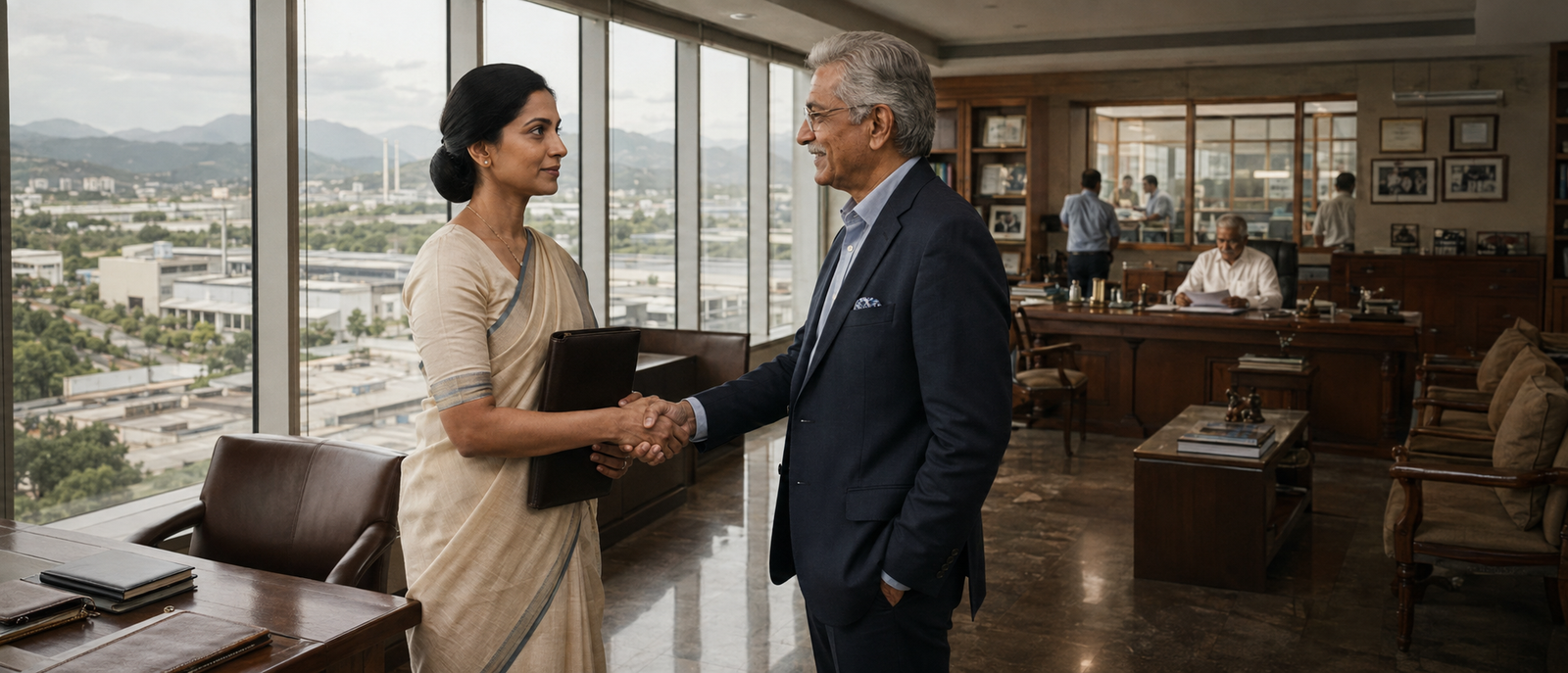
She flew in for it, because she runs that vertical. The buyer is Kirit Mehta — third generation, Ahmedabad, a man her father has sold to for twenty years and been to the weddings of. He came to her father’s seventieth last year and stayed past the point of politeness, and at some stage in the evening he found her by the buffet and told her, with real warmth, that he had watched her turn the vertical around, and that her father did not say so but was prouder than any of them. He meant it. He is that kind of man. Today he is here for the annual review, courteous in the way that takes two hours. He asks about the margin structure. She answers. He asks why they held Hubli through 2025 when the numbers said close it, and she walks him through it — her file, her note, her call — and he nods slowly, the nod of a man who has just been told something he did not know and found it good. He likes her. There is no part of this he is getting wrong. At the end he stands, gathers his phone, and asks — warmly, easily, the way you ask an old friend’s family after the old friend — when he might meet sir.
The most natural question

He does not know he has done anything. He has been buying from sir for twenty years, and in twenty years the person who signs has been sir. Kirit Mehta is seventy-one himself, tired in his own way, with a granddaughter just admitted to a college in Boston, and the question is the most natural one in the world. She can see, watching his face, that there is no second meaning in it. He is fond of her. He is also, without any contradiction he would ever feel, waiting to be taken to the man. She says next week, probably. He says good, good — pleased, already reaching for his phone to tell his driver he is coming down. They ride the lift together and he talks the whole way about the granddaughter, Boston, the cold there, whether she has taken enough sweaters, proud and spilling it over, and she says the right things and means them, because it is good news and he is a good man and she has known him since she was a girl. She feels nothing move in her about the sir. That is the part she will notice later.
A magnificent guest
Her father is seventy and comes in three days now. It used to be five. Nobody said anything about it; it just started, and then it was how the week went. On the three days he comes in, he is glad to see her in a way he has never once put into a sentence. He tells people her results. He told Kirit Mehta, probably, at the seventieth — that is where Kirit had it from. He paid for her MBA without a discussion, a better one than her brother’s, and when the acceptance came he read it twice and put his hand flat on the paper, as though it might lift off the table.
He has never asked her the question. Not out of cruelty. Her brother was not asked either — nobody sat him down. It was in how dinner went when he was twenty-two, in the way the file appeared on his side of the table, in what sir has always meant. Her father built the language for the business decades ago, and the language was built for a son, and it works, and he has never once heard the silence in it where a different sentence should be. He is proud of her the way you are proud of a magnificent guest.

No grievance form
So she did the thing she has always done, which is apply.
Good numbers. The turnaround in the vertical. Hubli, when Hubli was hers to lose. She has been applying to her own family for a thing her own family has — quarter after quarter, for fifteen years, without once letting the sentence finish itself, never calling it that, not in the car, not at eleven at night, not once — because to call it that she would have to be angry, and there is no one to be angry at.
Her father loves her. Kirit is kind. Her brother works hard and did not ask for the file to land on his side.
Everyone in it is a good person. That is the part with no handle on it.
She could raise it. But raise it how, and to whom, and against what — nobody did anything. There is no meeting for this. There is no form that reads:
I was valued my whole life, loudly, and never once asked.
The second question — the one about who a thing is handed to, and who is only ever admired near it — she has never let herself open. She has been in the building since she was twenty-six.

The question she has never let herself finish
Was she never excluded — or was she only never asked?

Forty seconds
The note came the next morning. Kirit, warm — he had been impressed, he wrote, and he had. She read it and replied. Warm back, the right length, a line about Hubli that he would like. Forty seconds, maybe. Then she forwarded the thread to her father’s office, because that is the next step and she has always known the next step. She was standing in the lift, on the way down to the car, before she understood that her hand had already done it. The forward. To sir’s office. Her thumb had sent it somewhere in those forty seconds and not thought to tell her.
The lift was mirrored on three sides, the way they are in these buildings, and she watched the floor numbers fall — nine, eight, seven — and waited to feel something about the thing her hand had done. What came was the reply. Warm, correct, already gone. She could not find anything underneath it. The doors opened at the lobby. Her driver was there, and the heat came in off the forecourt, and she got into the car and told him the airport, and it was somewhere past the second signal that she noticed she had been waiting, the whole way down, to mind.
And that she still hadn’t.