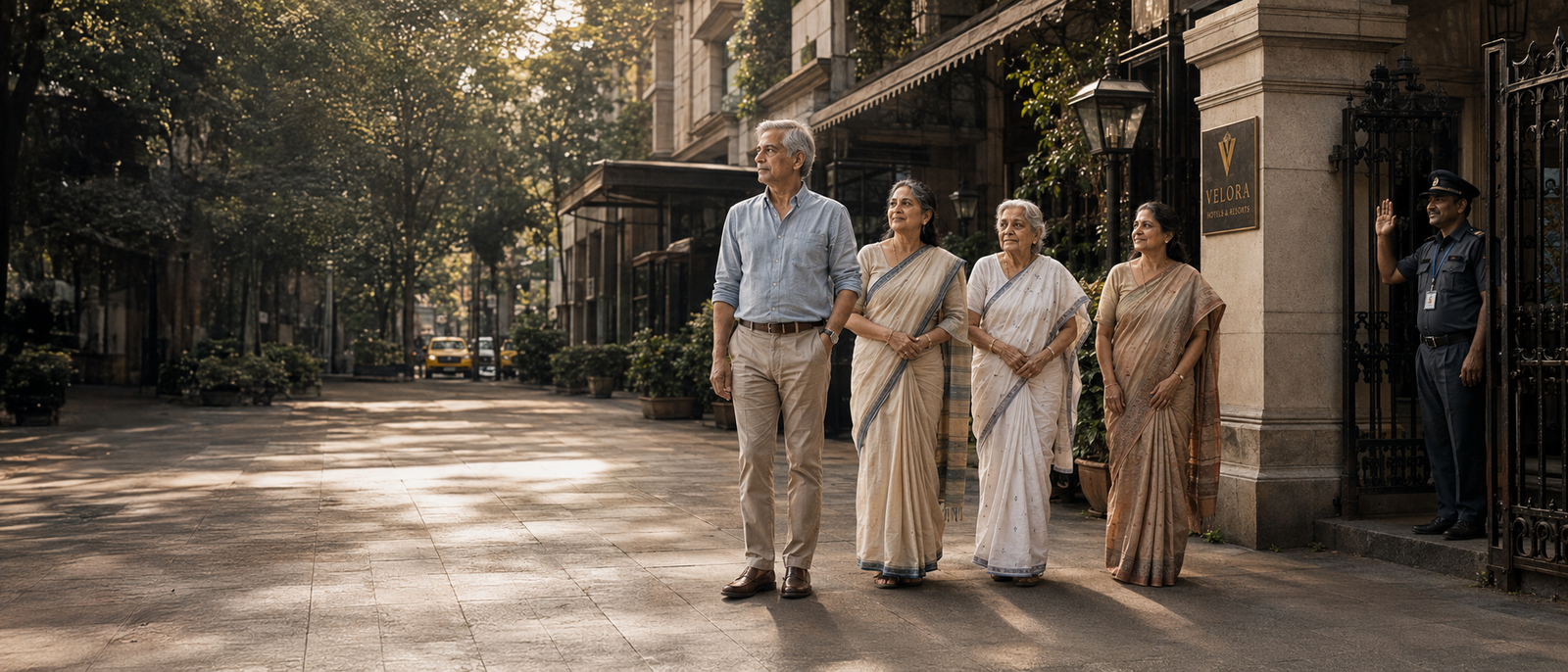
After the Exit
It is sold. It is Monday. Nothing is wrong.
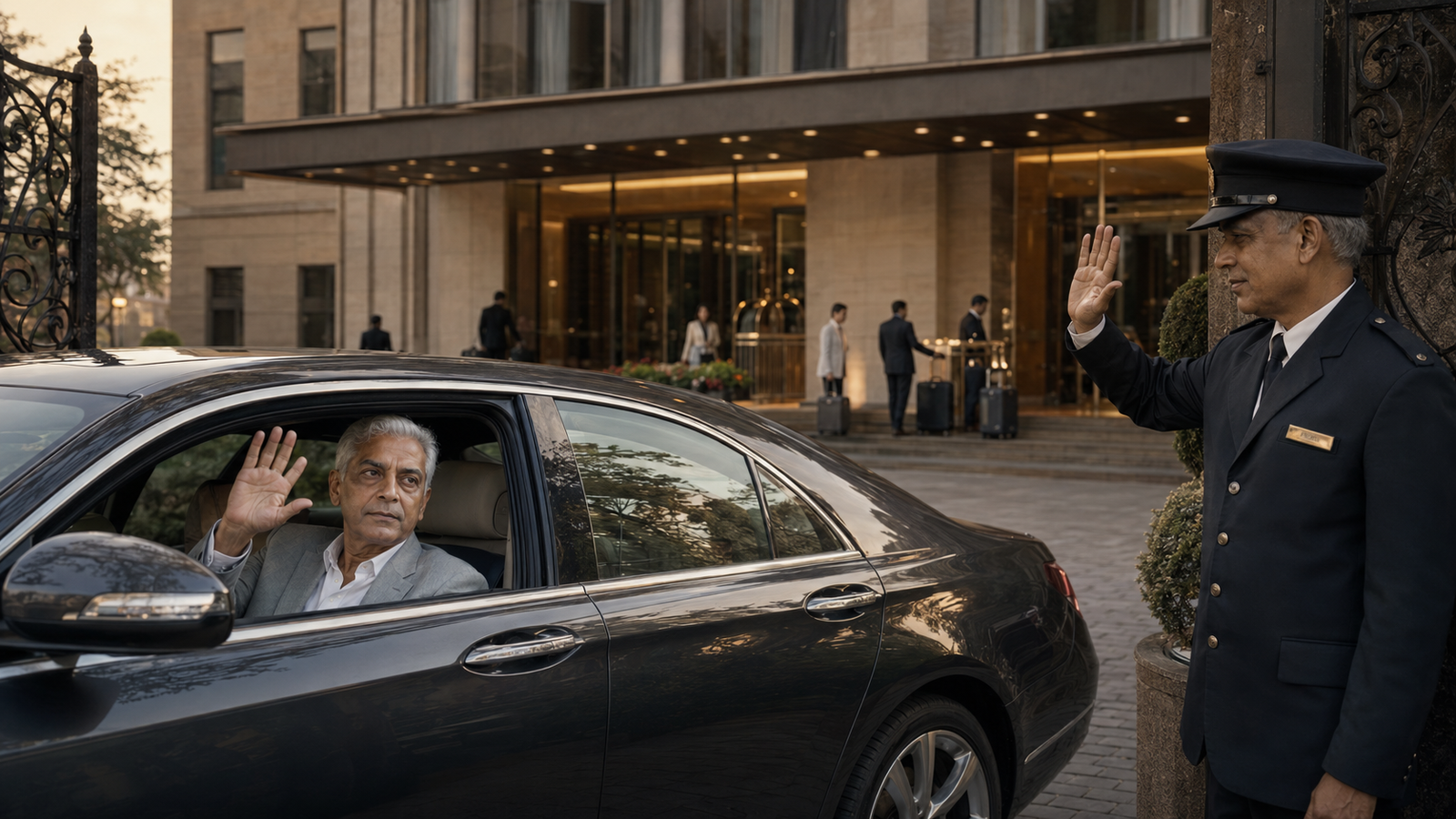
Six months, and the gate still knows him
He drove past it in January, on the way to the dentist, because the dentist is on that road now. The Regency was standing, and the hoarding carried the new name, which is his name, because that was part of what they bought. The man on the gate put a hand up. He has been on that gate since 2004. Bimal Palit raised a hand and kept going.
He came out in July, at the end of the two years he had agreed to stay. Ninety rooms, two banquet halls, thirty-four years, and a coffee shop that was somebody's idea in 1998 and stayed. On Thursdays he plays at Tolly with three men who also sold. Nobody has mentioned it once. That morning his phone had two messages. One about a birthday, and one from a bank confirming a deposit had rolled over, at a figure he did not read.
Forty and sixty
His grandfather held land at Rajarhat when it was fishery and paddy and a bad road. His father held it for thirty years and did nothing with it. Bimal put a hotel on one corner in 1991, when he was thirty-one. No lease was drawn and no rent was asked for, and it did not occur to anybody that permission was a thing that needed giving. Then the airport road came, and a township needed all of it in one piece. The valuation took most of a Thursday, in an office on Camac Street with the blinds down against the glare. Three men from the valuers, two from the fund, coffee at eleven that nobody drank. The land was quick. A rate per cottah, the airport road. The rest of the morning was the hotel. Occupancy off his own returns. A brand study. A deduction for the fact that the building was coming down.
By four they had a number. Forty per cent of the whole was the company and the name, and everybody shook hands, and one of them said congratulations. He was the only person from his family in that room. It had not occurred to him that anybody else should be. The other sixty went where the law sent it. His father died without a will in 2011, and that day the land became three shares, a widow's and a son's and a daughter's. In the memorandum it is one page with a footnote. He has read that page more than once. The bank that took the proceeds sent a man with a deck that had wealth psychology in it, and he was not wrong about any of it.
Thakuma, Didima
His sister Ruma married into Jamshedpur in 1984 and comes home four days at Puja most years. They speak on Sundays. Her knee, a cousin in Behala. She signed in July, at the sub-registrar's office. Their mother signed before her, eighty-two, and a clerk held the pad steady for her thumb. Afterwards the three of them had lunch at a place Bimal knew. Her third went into an account in Jamshedpur and she has not touched it.
In the twenty-two weeks between the lawyer's letter and that counter, not one person asked her what she thought. She has never mentioned it. Forty-two years is a long time to have been careful, and she was not going to stop being careful at sixty-three over a lunch. Her children are Sanyals and have never been Palits. Bimal's son Arnab calls the old woman Thakuma. Ruma's son Joy calls the same woman Didima. Then their mother turned eighty-five.
The eighty-fifth
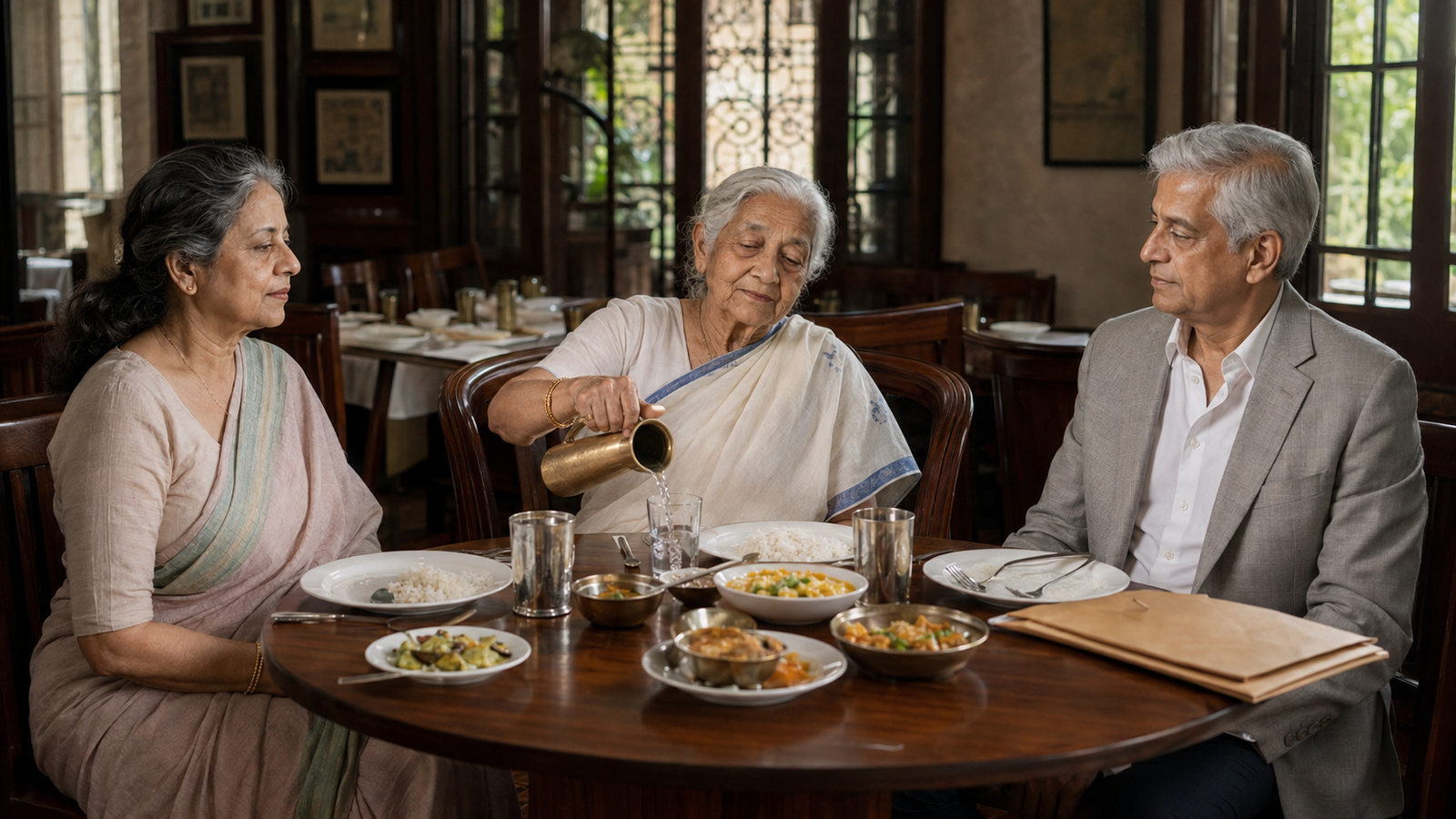
They did it at the Regency, in the smaller hall, four months after he handed the building over. Sixty-odd people, and half the room had worked there once. The banquet captain came out of retirement because he heard whose party it was, and was in the kitchen by four telling them the fish was wrong. Somebody's driver was fed twice. His wife Shipra was near the service door, where she always is, watching a tray go past and counting it.
Somewhere after the cake, Joy said it. He is thirty-six and he said it to nobody in particular, the way a thing gets said in a room that is already loud. That it was strange nobody had ever asked them what should happen to Dadu's land. Two people laughed. The room went on. He wrote a message that night to take it back and did not send it. And he is not wrong, which is why nobody answered him. Not his grandmother, who was four feet away. Not his uncle, who built the hall he was standing in. Bimal said nothing at the time. On the way out he asked the boy about his back. There is nobody a man can take that evening to. Not a banker, not the lawyer who did the deal, not a brother-in-law who was on a call by the lifts. Raghavan has stayed at that hotel on every Calcutta trip since it opened, and which of them was worth more never once came up. In January he rang Praveen Saanker, then he rang Bimal, then he did not raise it again.
Five months, and what they were for
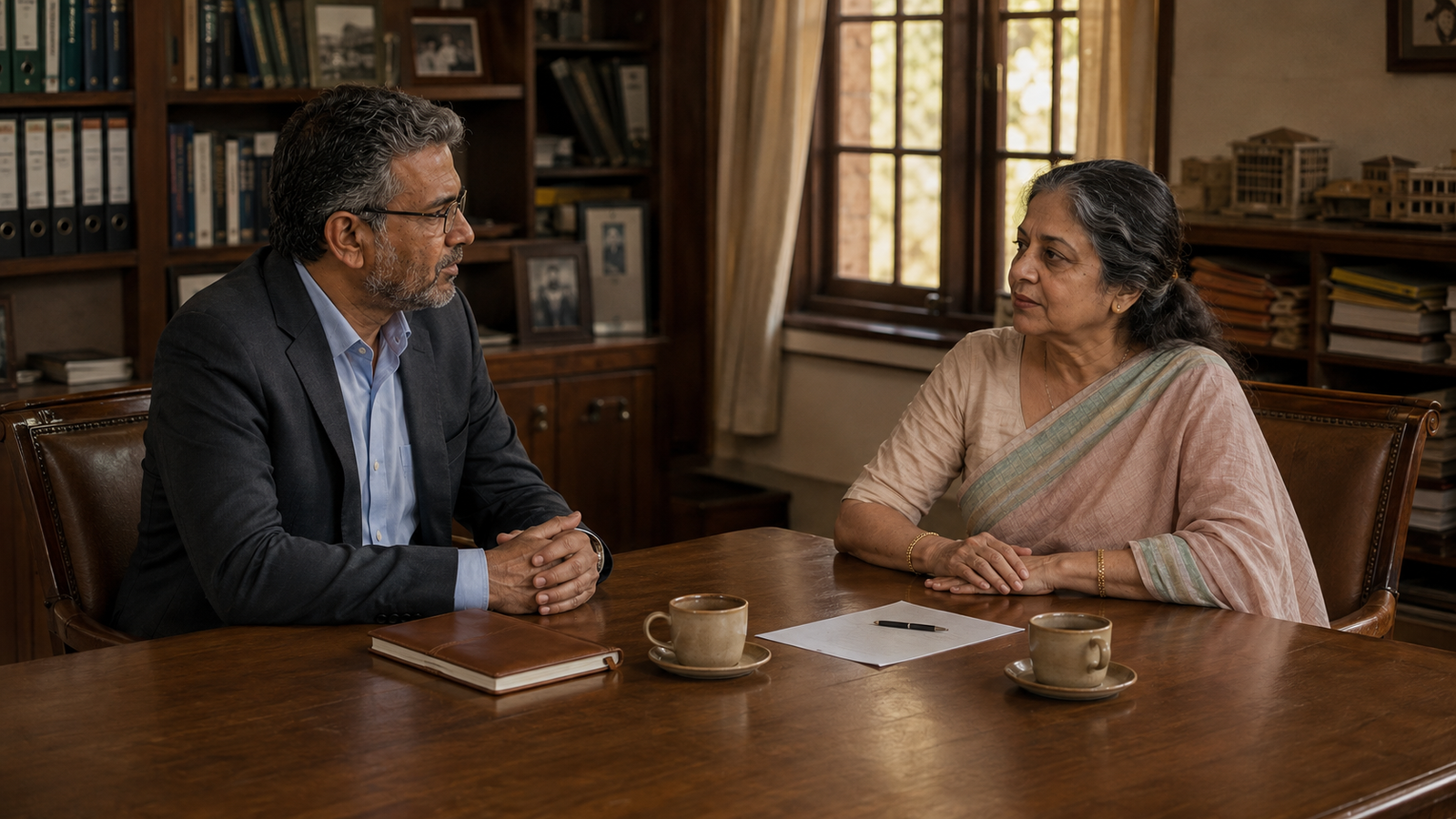
Praveen sees each of them alone, several times, over five months. Some run for hours and none is an interview. He starts with the woman whose birthday it was. She holds a third of the land money and she has no will, and both branches have been coming to her separately for three years. She has repeated none of it to either side. Ruma is seen twice at her own house in Jamshedpur. Asked what she thought when the letter came, she says her brother will have had his reasons. Asked again, put a different way, there is a long gap, and then she answers. Nobody had asked her anything about that family since 1984.
Bimal's first conversations are the deal, and he could do it from memory. Near the end of one he says his father never came to the hotel, not once in twenty years, and then goes back to the covenants. He mentions, without being asked, that he put the forty to two people in the first year. Both of them work for him. Arnab left a plan on his father's desk in March and has not raised it since. In two conversations he talks about the hotel instead, and the housekeeper who taught him to count linen at eleven. Nothing from any of it goes anywhere else. What five months turn up is that nothing in that house has ever been decided. Not the building in 1991, not the land in 2011, not the forty. For fifty years they decided things by not needing to, and it worked, because there was nothing to decide. Then a fund put every unmade decision in their history on one table with a completion date against it.
What Shipra had been doing since 1986

Every grievance in that family came to her. A sister-in-law's remark at a wedding. Whose name went on the card and in what order. Bimal was at the hotel six days a week and most evenings, so it came to her, and it stopped there. She has been doing it since 1986 and nobody ever called it anything.
After the sale it got bigger than she could take, and for the first time in forty years the trouble went past her and reached him. She says she has been better these last three years than she has been in twenty. Then she asks whether that is a terrible thing to have said. She goes out on Wednesday afternoons. He knows this. He has never asked where. None of it can be told to him. A question can be put where the man might reach it himself, and sometimes he does not.
The cheque
It comes up in the fourth month, in the car, coming back from the lawyer's. He has worked it out. Divide the forty. Or give Joy something and be done inside a week. He can afford every version of it at once, which is what makes it so easy to say in a car. Praveen tells him not to.
Money given to Joy answers a question Joy never asked, and cannot be taken back, and he will carry it for forty years as the year he was settled with. Bimal does not say anything for a while. Then he asks what the alternative is, in the voice of a man who does not think there is one. He is not told what the forty should have been. He asks twice more over the next month and does not get an answer, and he finds that harder than anything else in the five months.
What Ruma is asked, and in what order
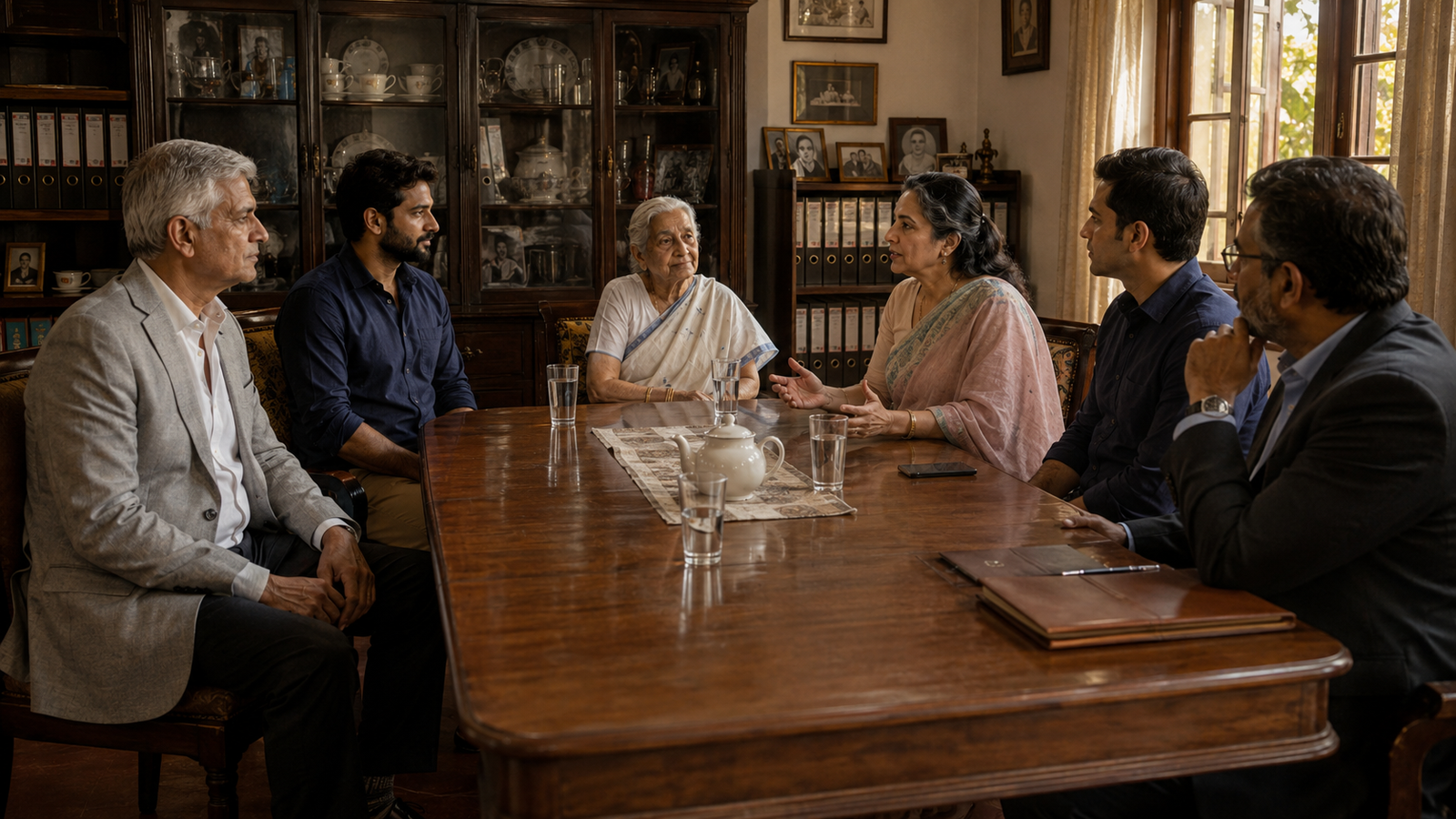
The house, not the Regency, in the room with the almirahs. Ruma is put at the middle of the long side, having sat at the end of that table since 1984. She is asked first, before her brother, and the question does not mention the sale. She is asked what she thinks their father would have wanted. She does not answer for a while. When she does she talks for a long time, and about four minutes in Joy turns his phone face down on the table. She says their father let her brother build on that land in 1991 and never once asked him for a rupee, and that this was their father answering the question, by saying nothing, the way he did everything.
Bimal has both hands on his knees. Then he says it. That the forty was decided by three men in an office on Camac Street, and that he was in the room and none of them were, and that he has not known since how to bring it up. Ruma tells him he is an idiot. She says it the way a younger sister does, in front of her mother and her children, and it is the first time in three years anybody has spoken to him without weighing it first. Their mother says she has lived in this house since 1962 and has not once heard anybody call it his father's hotel.
What gets written down
Their mother had never made a will. It takes four conversations and a lawyer at the house twice, and she has views nobody expected, one of which surprises Ruma more than her son. She has run that house on an older idea than any of these documents, which is that a person holds a thing for a while and does not own it.
Then a set of rules, used by both branches on their own money, the same date every year, and a fund they both pay into, so that money reaching a young family does not arrive from somebody's mother. Arnab's plan came back in October with part of it refused, in writing, against those rules. He took it. A refusal out of a policy is a decision, and a refusal from a father is a verdict. Joy did not ask for money. He asked to be on the thing that decides, and he is, and it was his uncle who proposed it. And Bimal has a sentence for saying no, which a man who has never in his life had to refuse anybody anything does not have. Both halves are done by one person in the same room. Two decades in institutional finance sit behind the instruments, at HSBC India and then as a founding-team Director of the family office practice at ASK Wealth Advisors. A doctorate in clinical psychology sits behind the rest. By the second year the thing keeping that family in a room is not him.
Wednesday
They took the building down in December. The name stayed up, on a hoarding, on the same road. Ruma came for four days, which was not Puja and not a wedding and not a reason. On the second morning the three of them went through it, because their mother wanted to. She walked most of it, Ruma on one side and Bimal on the other, neither of them holding her, because she does not allow it. She wanted to see the coffee shop. Nobody had expected the coffee shop.
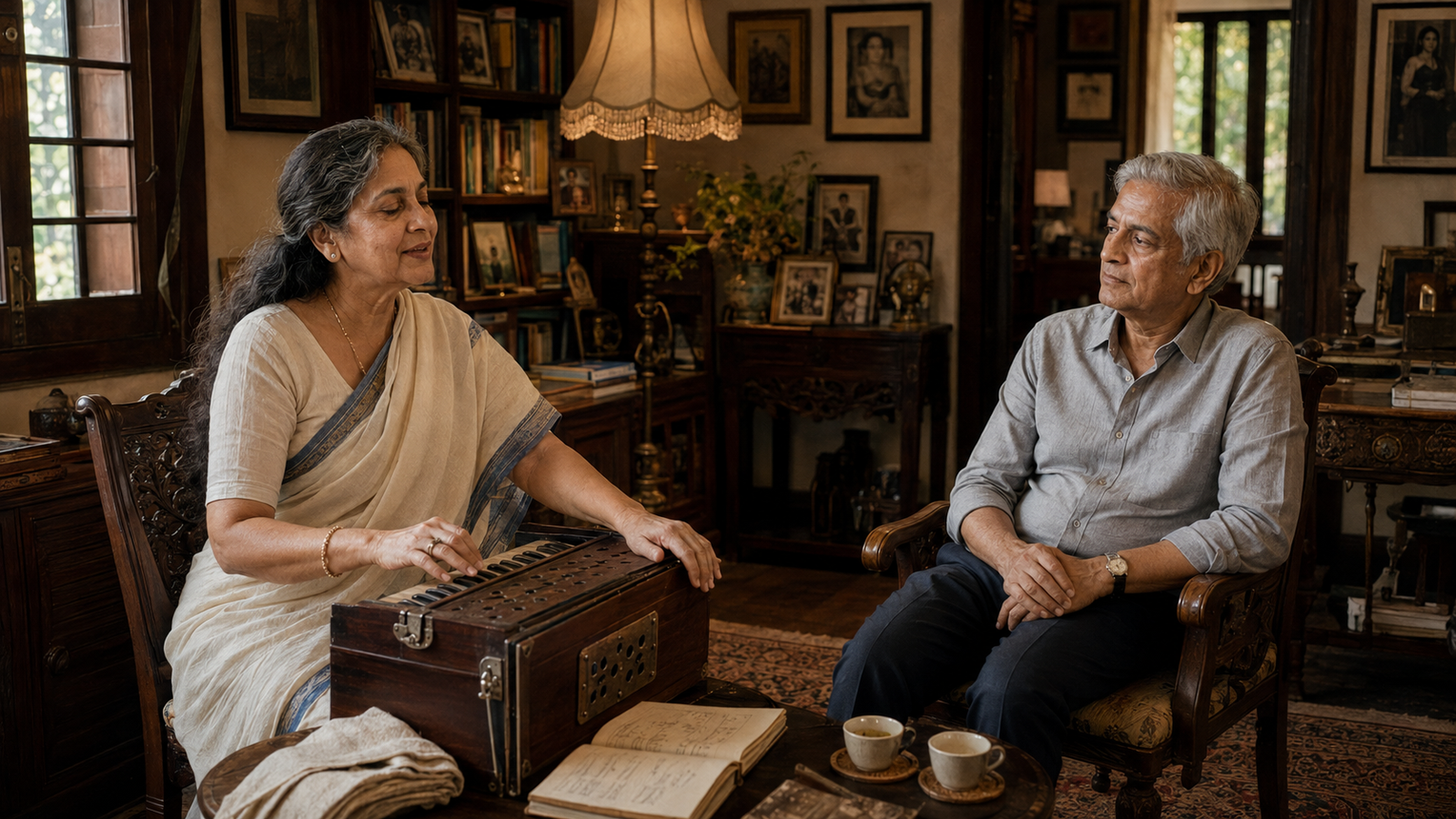
On the last evening, going out through the kitchens, Ruma said it was good that Boudi was singing again. Bimal said yes. He had thought it was about a year. It has been six. He asked her about it that week. Not where she goes. What they sing. Five women and a flat in Jodhpur Park. Atulprasad, which Shipra had not sung since she was twenty. He asked her to sing one. She said no. Then she went into the back room and got the harmonium out from behind the trunks, where it has been since 1986, and it was heavy, and he carried it in for her and set it down. Then he went and sat in the chair nearest the door, which is where he sat for thirty-four years, and she sang.